

You're paying for the wrong model
Imagine a delivery company that owns everything from bicycle couriers to a fleet of Formula 1 race cars — and yet sends an F1 car every time a customer needs a birthday card dropped off next door. That's roughly what's happening at most companies using AI right now. "Using an AI model" means sending a request to a large language model, or LLM — the technology behind tools like ChatGPT. These models come in different sizes and prices, from small, cheap, fast ones to huge, expensive, powerful ones. The catch is that many teams use the expensive, powerful model for every task, even trivial ones like sorting an email into a folder. The result is a fuel bill that makes no sense for the job being done.
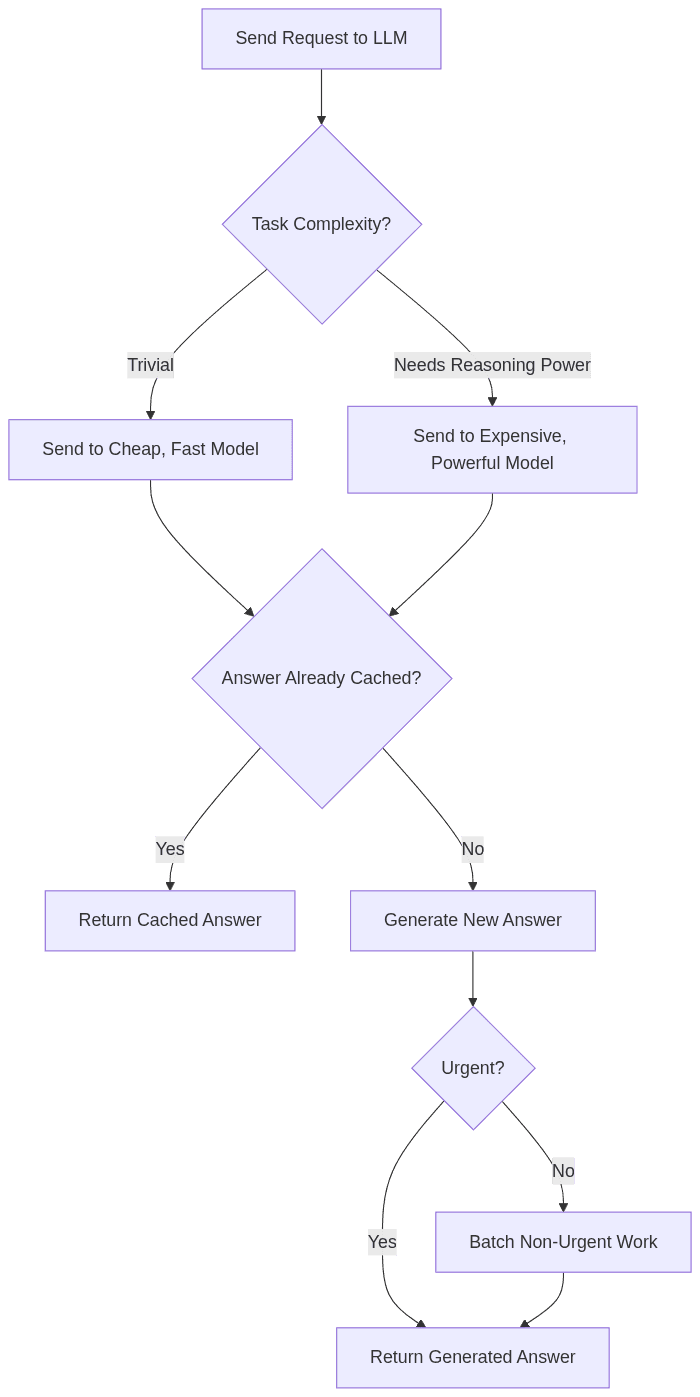
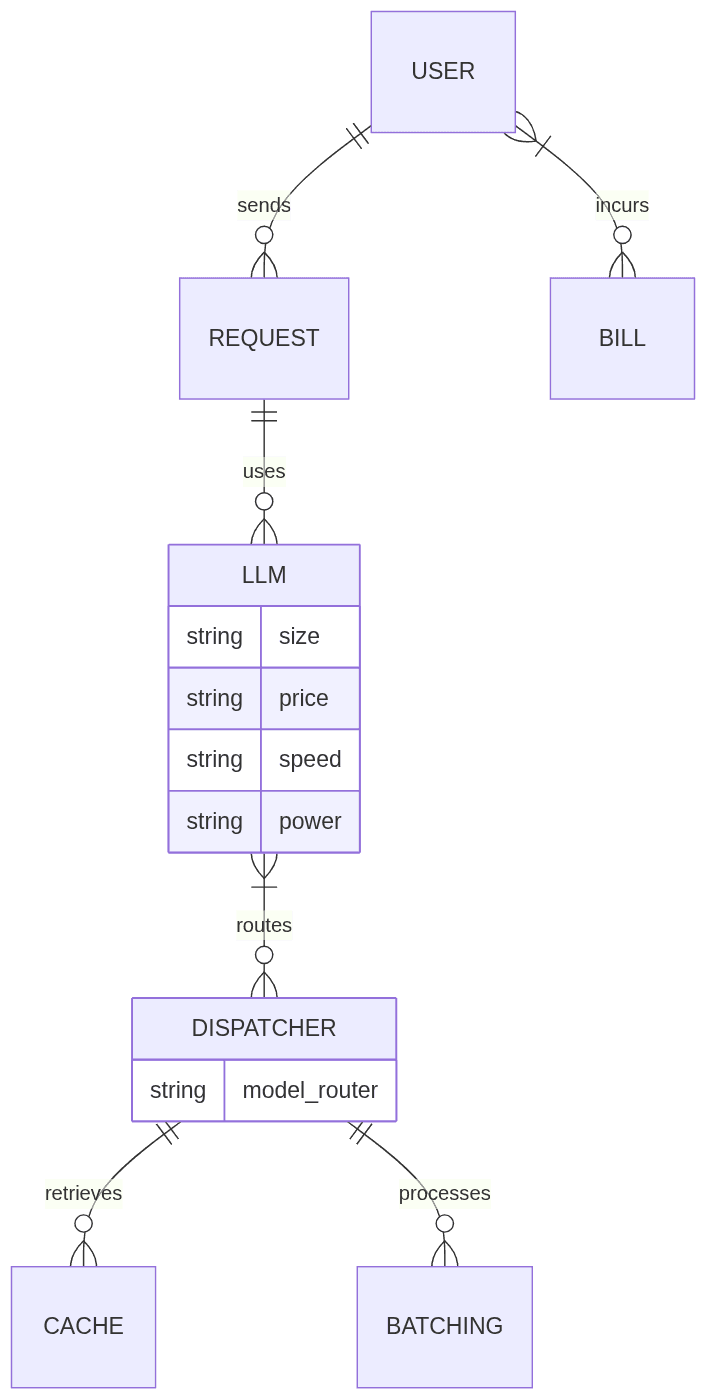
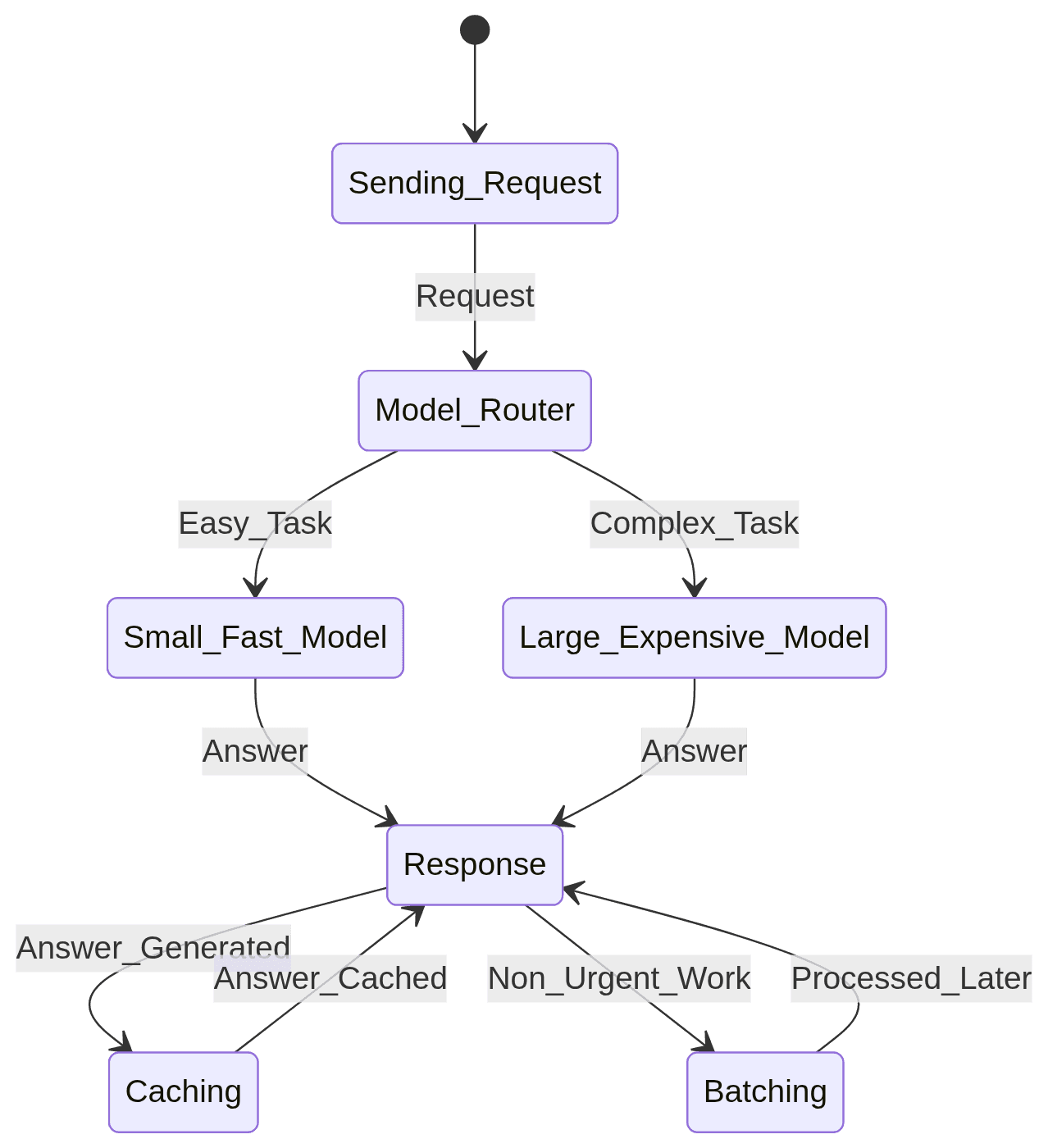
Cutting your LLM bill mostly comes down to matching the vehicle to the delivery. That means building a "dispatcher" — engineers call this a model router — that automatically sends easy jobs (like labeling a support ticket) to a cheap, fast model, and saves the expensive model for things that actually need its extra reasoning power. It also means not paying twice for the same trip: caching is simply keeping a copy of an answer you've already given, so if someone asks the same or a very similar question again, you hand them the saved answer instead of generating it from scratch. And for work that isn't urgent — like processing a batch of documents overnight — many providers offer a discount if you're willing to wait a few hours instead of demanding an instant reply, a practice called batching.
Put these together — right-sizing the model, caching repeat answers, batching non-urgent work, and trimming wordy instructions — and teams are cutting their AI bills by 50–80% with no drop in quality that customers would ever notice. This isn't about doing AI "on the cheap." It's about no longer paying premium prices for work a cheaper model could do just as well, or for an answer the system already generated five minutes ago.
How it works
The story is becoming unnervingly common. An engineering team ships a promising new AI feature. It works great. Usage grows. Then the bill arrives. One developer, Ari Vance, shared a now-infamous experience: a side project with 200 users racked up an $847 OpenAI bill in a single month [2].
This isn't a rare anecdote; it's a systemic issue. As AI tools become essential companions in the enterprise, the associated costs are spiraling [1]. Enterprise spending on LLMs reportedly more than doubled in a single year, from $3.5 billion in 2024 to $8.4 billion in 2025 [2]. The root cause is almost always the same: processing too many tokens in redundant and inefficient ways [1]. Most development teams, according to one analysis, squander 40-60% of their token budgets on suboptimal implementations [2].
The good news is that this waste is recoverable. The following strategies form a practical framework for reclaiming your budget without degrading your product.
### Strategy 1: Model Routing and Right-Sizing (The 16x Difference)
The single biggest source of wasted LLM spend is using a frontier model for every request [3]. A team ships their first feature using a model like GPT-4o because it's the best and most capable. As they add more features — summarization, classification, data extraction — they default to the same model. Six months later, 80% of their inference spend might be on a top-tier model that's just classifying support tickets into five categories [3].
This is a catastrophic financial mistake. The cost per request can vary by over 120x depending on the model you call [2].
Consider the pricing for OpenAI's latest models [3]:
GPT-4o (the "F1 car"): $2.50 per million input tokens, $10.00 per million output tokens.
GPT-4o mini (the "cargo van"): $0.15 per million input tokens, $0.60 per million output tokens.
That's a 16x price gap on input tokens alone. For many common enterprise tasks — like classification, summarization, and routing — the cheaper GPT-4o mini performs just as well as its powerful sibling [3].
Worked Example: The $2,350 Decision
Imagine you have a feature that classifies 1 million customer support emails per month.
Using GPT-4o: At $2.50 per million input tokens, your bill is $2,500.
Using GPT-4o mini: At $0.15 per million input tokens, your bill is $150.
You are performing the exact same task, but one choice costs $2,350 more than the other [3].
The solution is model routing or model selection. This involves building a lightweight layer in your application that intelligently routes each request to the cheapest model that can meet the quality bar for that specific task [4]. This "router" can be a simple classifier that looks at the user's prompt, or it can be a more complex "fallback chain" that starts with the cheapest model and escalates to a more powerful one only if the first attempt fails or returns a low-confidence score [4].
### Strategy 2: Caching for Zero-Cost Inference
Getting a 16x cost reduction is great, but what's better than cheap? Free. Caching makes this possible by ensuring you never pay to answer the same question twice. Many applications see the same or similar requests over and over. Without caching, you pay the full API price for the LLM to generate the same response every single time.
There are two primary forms of caching [4]:
Exact-Match Caching: This is the simplest form. The system creates a unique identifier (a hash) of the normalized prompt. Before calling the LLM, it checks if a response for that exact hash already exists in its cache (like a Redis or DynamoDB table). If so, it returns the saved response instantly, at near-zero cost.
Semantic Caching: This is more powerful. Instead of looking for an exact text match, it looks for prompts that are conceptually similar. It does this by converting the incoming prompt into a vector embedding (a numerical representation of its meaning) and searching a vector database for prompts with a similar meaning. If a sufficiently similar past query is found, the cached response is returned. This can achieve a high cache hit rate even if users phrase their questions slightly differently [4].
The savings are dramatic. Hitting your cache means zero-cost inference for that request. Even the API providers are building this in. Anthropic's prompt caching feature can reduce costs on cached inputs by 90%, while OpenAI's equivalent offers a 50% reduction [3]. A well-implemented caching strategy can achieve a 30-60% overall hit rate, effectively eliminating a huge chunk of your bill [4].
### Strategy 3: Prompt Engineering for Cost
The price you pay for an LLM call is directly tied to the number of tokens you send (input) and receive (output). Therefore, one of the most direct ways to cut costs is to reduce the number of tokens in every transaction. This is the goal of cost-focused prompt engineering. It's not about improving quality (though that can be a side effect); it's about achieving the same quality with less verbosity.
This can reduce token usage by 50-70% [4]. Key techniques include:
System Prompt Compression: Review and ruthlessly shorten the instructions you give the model. Remove redundant phrases, examples, and wordy explanations.
Structured Output: Instead of asking the model to "explain the result in a paragraph," force it to return a structured format like JSON. This eliminates conversational filler and makes the output predictable and machine-readable, drastically cutting output token counts [4].
Context Management: For multi-turn conversations (like a chatbot), you don't always need to send the entire chat history with every new message. Implement strategies like summarizing the conversation so far, or using a sliding window to only include the most recent turns.
### Strategy 4: Batching for Asynchronous Discounts
Not every LLM call needs to happen in real-time. Tasks like report generation, document analysis, or data enrichment can often be done in the background. For these workloads, speed is less important than cost.
OpenAI's Batch API is designed for exactly this scenario. By submitting a large file of non-urgent requests to be processed asynchronously, you can receive a 50% discount off the standard API price [3]. The API will process the requests as compute becomes available and return the results within 24 hours.
If you have any workload that doesn't need an immediate, user-facing response, batching is a simple and highly effective way to halve its cost.
### Strategy 5: The Long Game - Fine-Tuning
For high-volume, specific tasks, fine-tuning can offer the greatest savings. This involves taking a smaller, cheaper open-source or base model and training it on your own data to become an expert in a narrow domain.
The result is a specialized model that can outperform a general-purpose frontier model on your specific task, at a fraction of the inference cost. While the initial effort is higher than the other strategies, the payoff can be immense. For the right workloads, replacing a premium API model with a self-hosted, fine-tuned model can lead to savings of over 80% [4]. This is the end-game for structurally optimizing the highest-volume workflows in your system.
What this means in practice
For engineering and product leaders, the era of treating LLM APIs as a magical, infinitely scalable utility with no financial guardrails is over. Cost optimization is rapidly becoming a core operational discipline [1]. The first step is visibility: knowing exactly which model is being called, how often, and why. As one developer noted, "The terrifying part isn't the spend itself. It's the complete absence of visibility" [2]. Implementing cost attribution — tracking which feature, user, or team is driving spend, the same way a business might track which product line is eating its budget — is the foundation upon which all these optimization strategies are built [3]. Without it, you are flying blind, unable to tell whether last month's spike came from one heavy user or a company-wide inefficiency.
This marks a shift in mindset for developers. Building an AI feature is no longer just about getting the right output; it's about getting the right output for the right price. Teams must now benchmark tasks not just for quality but for cost-performance, asking, "What is the absolute cheapest model that can accomplish this task to an acceptable standard?" — the same instinct that makes you choose the bus over a taxi for a routine commute, while still calling the taxi when you're late for a flight.
For businesses, this discipline is the difference between AI-driven profitability and AI-driven margin erosion [4]. As AI features become more deeply embedded in products, their operational cost becomes a major line item, much like electricity or cloud hosting. An unoptimized AI architecture can see costs grow faster than revenue — meaning every new user makes the product a little less profitable rather than more — turning a promising feature into a financial liability. Effective optimization flips this: as usage scales, the cost per user goes down, so the business actually benefits from the growth the AI feature drives.
For end-users, the impact is largely invisible, which is precisely the point. A well-executed cost optimization strategy reduces spend without sacrificing output quality or response speed on the tasks that matter [1, 4]. It ensures that the AI-powered services they rely on can remain affordable, accessible, and financially sustainable for the companies that provide them.
Where this is heading
The strategies outlined here represent a snapshot of a rapidly evolving field. We are moving away from monolithic architectures, where a single do-everything model handles every request, toward something closer to a well-run kitchen with different cooks assigned to different dishes based on skill and cost.
The sources point towards a future where multi-model systems are the default. We can expect to see more sophisticated routing and orchestration layers — the "dispatcher" software described earlier — become standard components of any serious AI product. Companies will not just pick one provider like OpenAI or Anthropic; they'll use several at once, shifting requests between them in real time based on which is currently cheapest, fastest, or best suited to the task, much like a shipping company comparing couriers before every parcel goes out [4]. The intelligence of an application will increasingly live not in the model itself, but in the system deciding which model to call and when.
Reading beyond what the sources state directly: a new category of tooling — call it "LLM financial operations," combining cost tracking with performance monitoring — seems likely to become essential infrastructure. The "complete absence of visibility" [2] that developers currently complain about is a gap the market will move to fill. Expect platforms that go beyond a simple billing dashboard, offering per-feature and per-user cost breakdowns, automatic suggestions for cheaper routing, and forecasts of what next month's bill will look like if usage patterns continue.
Ultimately, cost optimization is not a one-time project; it's an ongoing habit, closer to maintaining a budget than filing taxes once a year. As new, cheaper models are released and pricing changes, yesterday's optimal setup becomes today's overspend. The teams that come out ahead won't be the ones who pick the "best" model today — they'll be the ones who build the habits and tooling to keep re-checking that choice, task by task, every day.