

Your most expensive mistake is the easiest to fix
Your LLM bill arrives, and buried in it is a charge for a "frontier model" — one of the most advanced, most expensive AI systems on the market — answering a question like "what are your business hours?" That's not a hypothetical scenario. It's the default outcome for teams that treat a large language model (LLM, the technology behind chatbots like ChatGPT) as a universal problem-solver.
The mistake is understandable. Wiring up one powerful AI service is simpler than building a more complex system with several moving parts. But as of 2026, the cost gap between the cheapest usable model and the most capable one is roughly 100x. Models are billed by the "token" — a token is roughly a word or word-fragment, and providers charge per million tokens processed. According to an analysis by Digital Applied, the price per million input tokens ranges from around $0.44 to over $30 depending on the model. When the exact same question can cost a fraction of a cent with one model or several cents with another, the decision of where to send that question becomes one of the biggest levers you have for controlling cost.
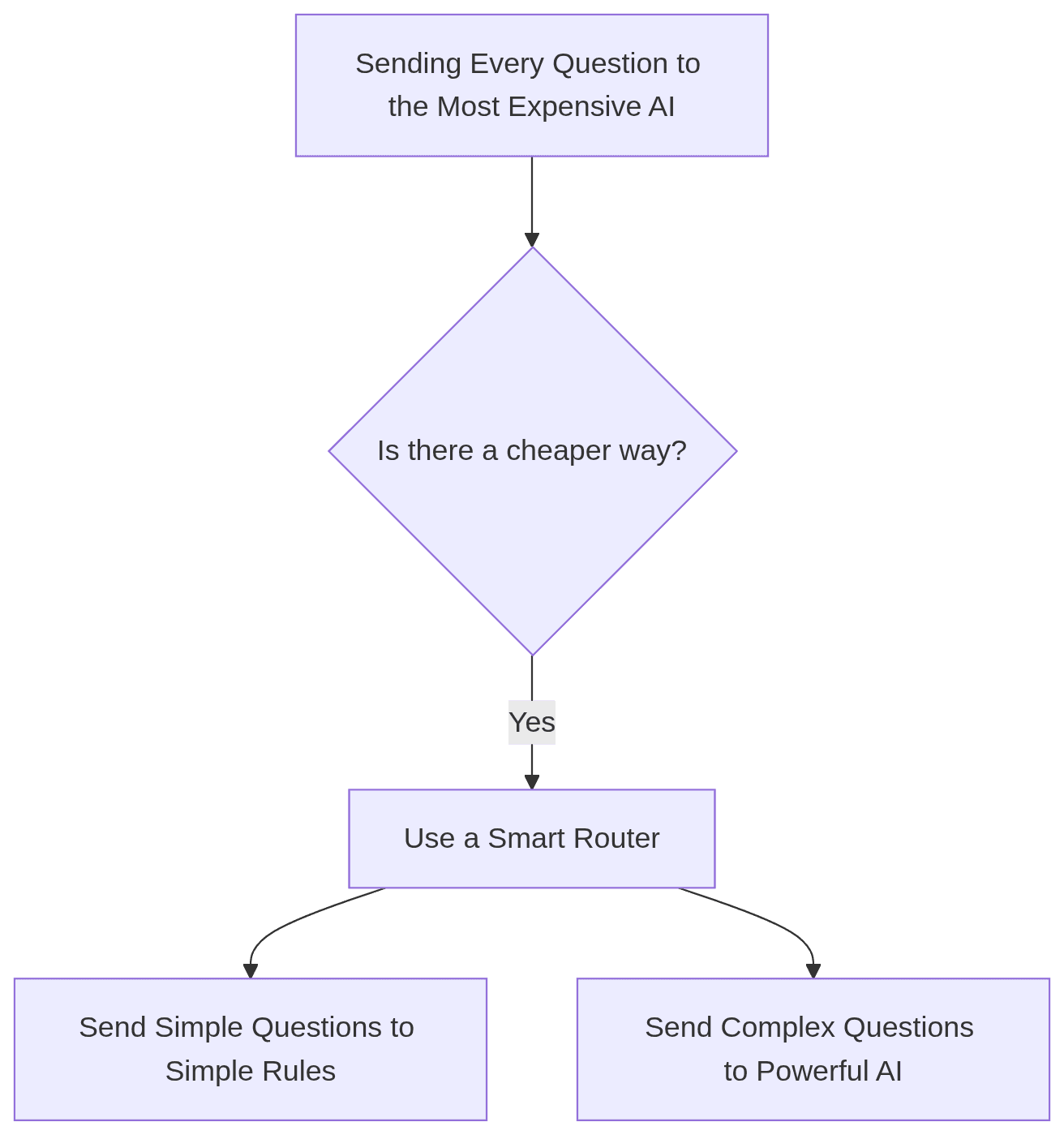
This is the job of a "router": a piece of software that sits between your application and the pool of models you have access to, deciding where each incoming request should go. Instead of sending every question to the most powerful — and most expensive — option, a router directs each query to the right tool for the job. Sometimes that's a sophisticated reasoning model. Sometimes it's a cheap, fast one. And often, the right tool isn't a model at all — it's a simple, fixed rule that gives a correct, instant, nearly free answer. Knowing when not to call an LLM is the router's best trick.
The siren call of the single endpoint
Let's be honest about why so many applications start with a single, powerful LLM for every task. It's easy. You pick the industry-leading model because it's a safe bet, capable of handling chat, summarization, classification, and code generation. You write the integration once. You have one API key to manage, one set of documentation to read, and one bill to pay. In the early stages of a project, this simplicity is a virtue. It lets you move fast and prove out a feature without getting bogged down in infrastructure.
The problem is that this "temporary" solution often becomes permanent. The feature works, users like it, and the team moves on to the next fire. Meanwhile, the application is quietly racking up costs by using a sledgehammer to crack nuts.
A support bot uses a frontier model to tell a user the company's address.
A content-tagging system uses a complex model to classify an article as "sports" when the keyword "basketball" is in the title.
An e-commerce site uses an LLM to answer "do you ship to Canada?" when the answer is in a static configuration file.
In each case, the model is being used not for its reasoning ability, but as a fuzzy-matching search engine. It works, but it's slow, expensive, and surprisingly fragile. The same question, phrased slightly differently, might get a different answer. A minor change in the model's training data or a new system prompt can cause it to hallucinate or refuse to answer. You're paying a premium for a tool that is both overkill and less reliable than the alternative.
This is the trap of convenience. The path of least resistance during development leads to a path of maximum cost in production. The fix is to introduce a new layer of logic: the router.
What a model router actually does
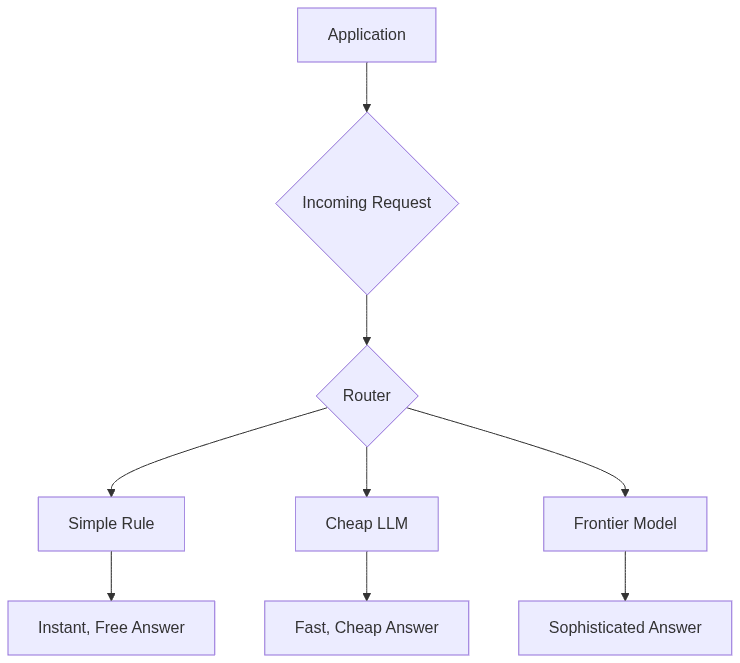
A model router is a decision-making layer that intercepts a request from your application and decides which model — or which system — should handle it. As described in a guide by Redis, it acts as middleware, weighing signals to pick the best destination for a prompt.
The three primary jobs of a router, as often categorized by platforms like Braintrust, are managing resilience, cost, and quality.
Resilience routing
The simplest form of routing exists to keep your application online even if a model provider has an outage. If the primary model returns an error or times out, the router automatically retries the request with a designated fallback model. This might involve sending the request to a different provider (e.g., failing over from OpenAI to Anthropic) or to a different model from the same provider. The goal is to keep the application functional, even if it means temporarily using a less-capable or more-expensive model. Success is measured in uptime.
Cost routing
This is the most common motivation for building a router. A cost-based router aims to send every request to the cheapest model that can successfully handle it. Teams implementing a tuned routing layer report bill reductions in the 40-85% range.
This works because most queries in production applications are simple and don't require complex, multi-step reasoning. By identifying these simple queries and sending them to smaller, cheaper models, you can reserve the expensive, frontier models for the small percentage of queries that genuinely need them. The router makes this decision based on rules, query complexity, or other signals. Success is measured in dollars saved.
Quality routing
The most sophisticated routers make decisions based on the expected quality of the response. Instead of just picking the cheapest model, a quality-based router tries to predict which model in its pool will provide the best answer for a specific query. This is a much harder problem, as "quality" is subjective and task-dependent.
Researchers from Microsoft and the University of Massachusetts, Amherst, have developed a framework that uses a cross-attention mechanism to model the relationship between a query and a pool of available models. Their system learns to predict both the likely quality and the cost of the response from each model, allowing it to make a nuanced trade-off. On a public benchmark, this approach improved quality by up to 6.6% over existing routers. Success here is measured by user satisfaction or other downstream metrics.
The best route is sometimes no model at all
While routing between different LLMs is powerful, it misses the single biggest optimization available: not calling a model in the first place. For any question that has a single, verifiable, and unchanging answer, an LLM is the wrong tool. It introduces unnecessary cost, latency, and non-determinism.
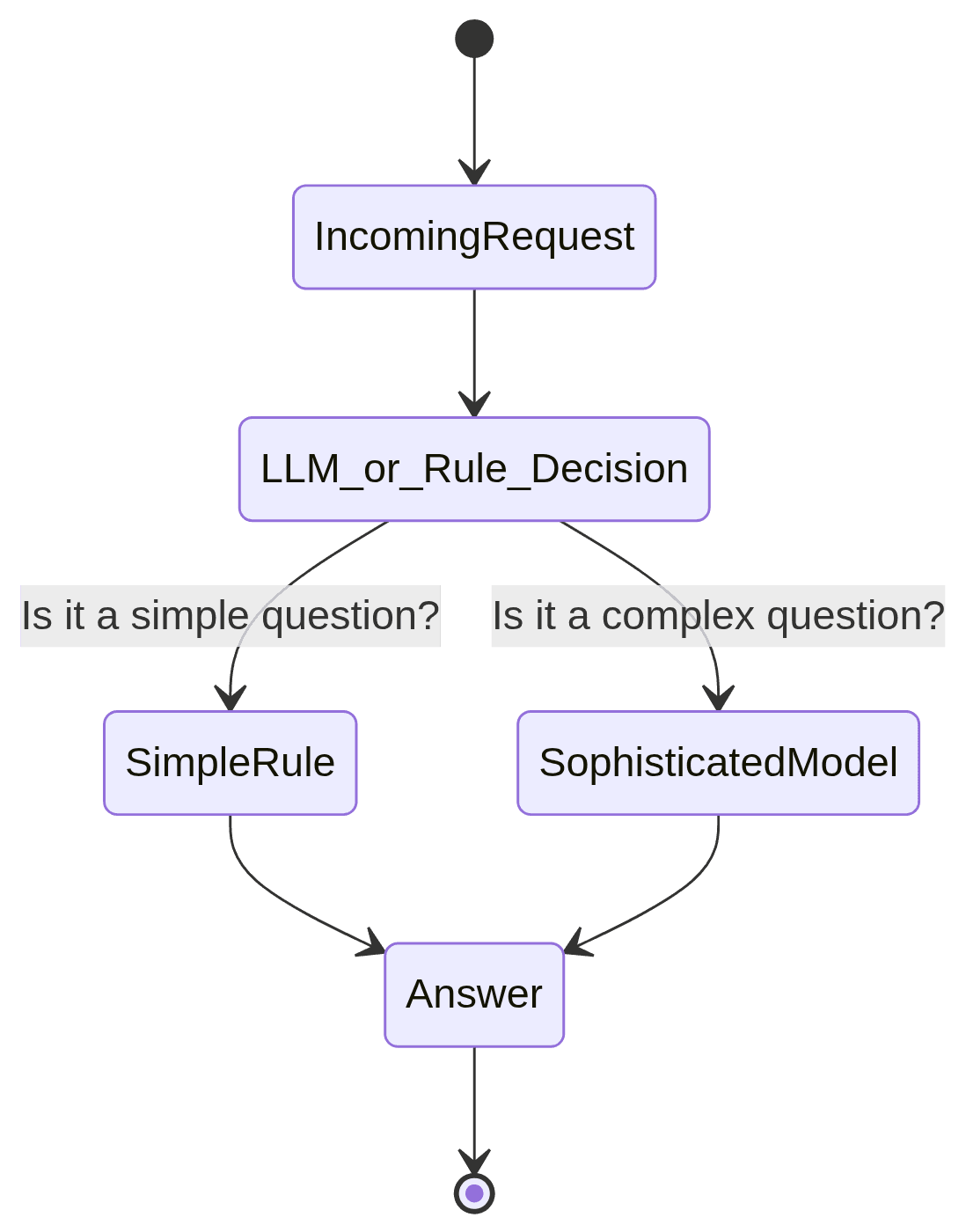
This is where rule-based routing comes in. Instead of just routing between models, a smart router should first check if the query can be answered by a simple, deterministic rule.
Deterministic: The same input always produces the same output. An LLM can give slightly different answers to the same query, but
if "hours" in query: return "9-5"is perfectly consistent.Fast: A dictionary lookup or a series of
if/elsechecks executes in microseconds. An LLM call involves a network roundtrip and a computationally intensive generation process, taking hundreds of milliseconds to several seconds.Cheap: The computational cost of a simple rule is effectively zero compared to a model call.
Auditable: You know exactly why a specific answer was given. It wasn't the opaque result of a neural network's internal state; it was the result of a line of code you can point to.
Integrating this logic turns your router into a more powerful, multi-stage system. A request arrives, and the router first checks it against a set of deterministic rules. If a rule matches, the router returns the hardcoded answer immediately. No model is called, no tokens are spent. Only if no rule matches does the request proceed to the model routing layer, which then decides which LLM is best suited for the job.
A worked example: From dumb bot to smart agent
Imagine building a support agent for an e-commerce store.
Version 1: The Single-Model Bot Every user message goes to a frontier model, regardless of complexity.
def handle_query(query):
    # Sends every query, simple or complex, to the most expensive model
    return gpt_5_client.chat(query)

# "what are your hours?" -> costs $0.02
# "do you ship to france?" -> costs $0.02
# "compare the warranty on product A vs product B" -> costs $0.02
This is simple to build but incredibly inefficient.
Version 2: The Cost-Routing Bot You add a router that classifies queries by complexity and sends them to different models.
def handle_query_with_model_routing(query):
    # A cheap classifier model decides if the query is simple
    complexity = fast_classifier_model.predict(query)

    if complexity == "simple":
        # Route to a cheap, fast model
        return cheap_model.chat(query)
    else: # complexity == "complex"
        # Reserve the expensive model for hard questions
        return gpt_5_client.chat(query)

# "what are your hours?" -> cheap_model -> costs $0.001
# "do you ship to france?" -> cheap_model -> costs $0.001
# "compare the warranty on product A vs product B" -> gpt_5_client -> costs $0.02
This is a huge improvement. You've cut the cost of simple queries by over 95%. But you're still paying for a model to answer questions with fixed answers.
Version 3: The Rule-Based Router You add a deterministic layer that runs before the model router.
# A simple dictionary of rules
DETERMINISTIC_RULES = {
    "hours": "Our business hours are 9 AM to 5 PM, Monday to Friday.",
    "shipping_policy": "We ship to the US, Canada, and Western Europe. For details, see /shipping.",
    "return_policy": "You can return any item within 30 days. Start your return at /returns."
}

def handle_query_with_rule_based_router(query_text):
    # Stage 1: Check deterministic rules
    q_lower = query_text.lower()
    if "hour" in q_lower or "open" in q_lower:
        return DETERMINISTIC_RULES["hours"]
    if "ship" in q_lower and ("france" in q_lower or "canada" in q_lower):
        return DETERMINISTIC_RULES["shipping_policy"]

    # Stage 2: If no rule matches, proceed to model routing
    complexity = fast_classifier_model.predict(query_text)
    if complexity == "simple":
        return cheap_model.chat(query_text)
    else: # complexity == "complex"
        return gpt_5_client.chat(query_text)

# "what are your hours?" -> Rule match -> costs $0.00001
# "do you ship to france?" -> Rule match -> costs $0.00001
# "compare the warranty on product A vs product B" -> gpt_5_client -> costs $0.02
This is the optimal architecture. The most common, simplest questions are answered instantly and for free. The models are only engaged when their unique capabilities — understanding nuance, synthesizing information, and performing complex reasoning — are actually needed.
Building an auditable and maintainable router
A router that you can't understand is just another black box. To make this system work in production, you need to build it for observability and maintainability.
Logging and tracing
Every routing decision must be logged. For any given request, you need to be able to answer:
Did it match a rule? If so, which one?
If not, which model was it routed to?
Why was that model chosen? (e.g., what was the output of the complexity classifier?)
What was the latency of the routing decision itself?
What was the final cost and latency of the entire request?
This data is crucial for debugging, cost analysis, and performance tuning. It allows you to spot trends, such as a new type of user query that should be handled by a rule, or a case where your complexity classifier is consistently making the wrong choice.
Proxy vs. recommendation
It's important to distinguish between two types of routers. Some routers, like NVIDIA's LLM Router, are recommenders. They take a query and return the name of the model that should handle it. Your application is then responsible for making the actual API call to that model.
Other routers act as a proxy. Your application makes one call to the router, and the router handles the downstream call to the selected model, returning the final response.
The proxy approach is generally more powerful. Because it sits in the middle of the entire transaction, it can manage retries and fallbacks, centralize logging, and provide a unified interface to your application even as you add or remove models from the pool. A recommendation router pushes that complexity back onto the application layer.
The decision boundary is a maintenance boundary
The hardest part of rule-based routing isn't writing the rules — it's keeping them current. Someone has to update the "hours" rule when the hours change, or add a new entry when a product launches. That upkeep is real work, and it's the trade-off you're accepting in exchange for near-zero cost and instant answers: a rule is cheap to run but not free to maintain, while an LLM is expensive to run but can often be "updated" simply by handing it fresh context or documentation.
So the choice between a rule and a model isn't really about how hard the question is — it's about how stable the answer is.
Use a rule for: information that is stable, universal, and low-ambiguity. Business hours, return policies, office locations, and simple feature specs are perfect candidates.
Use a model for: information that is dynamic, personalized, or requires pulling together multiple sources. "Summarize my last five support tickets," "What's a good gift for my dad who likes fishing?", or "Explain the difference between these three technical documents" all demand a model's reasoning.
The goal isn't to get rid of models — it's to draw a clear line between what a fixed rule can answer and what genuinely needs a model, and to treat that line as a deliberate design choice rather than an accident of how the system grew. Revisit it as your product and your users' questions change. Teams that put the rule-based layer first end up with something cheaper, faster, and more predictable by default — and they're forced to have an honest conversation about when, and why, they actually need to spend money on an LLM at all.