
A bigger window is a bill
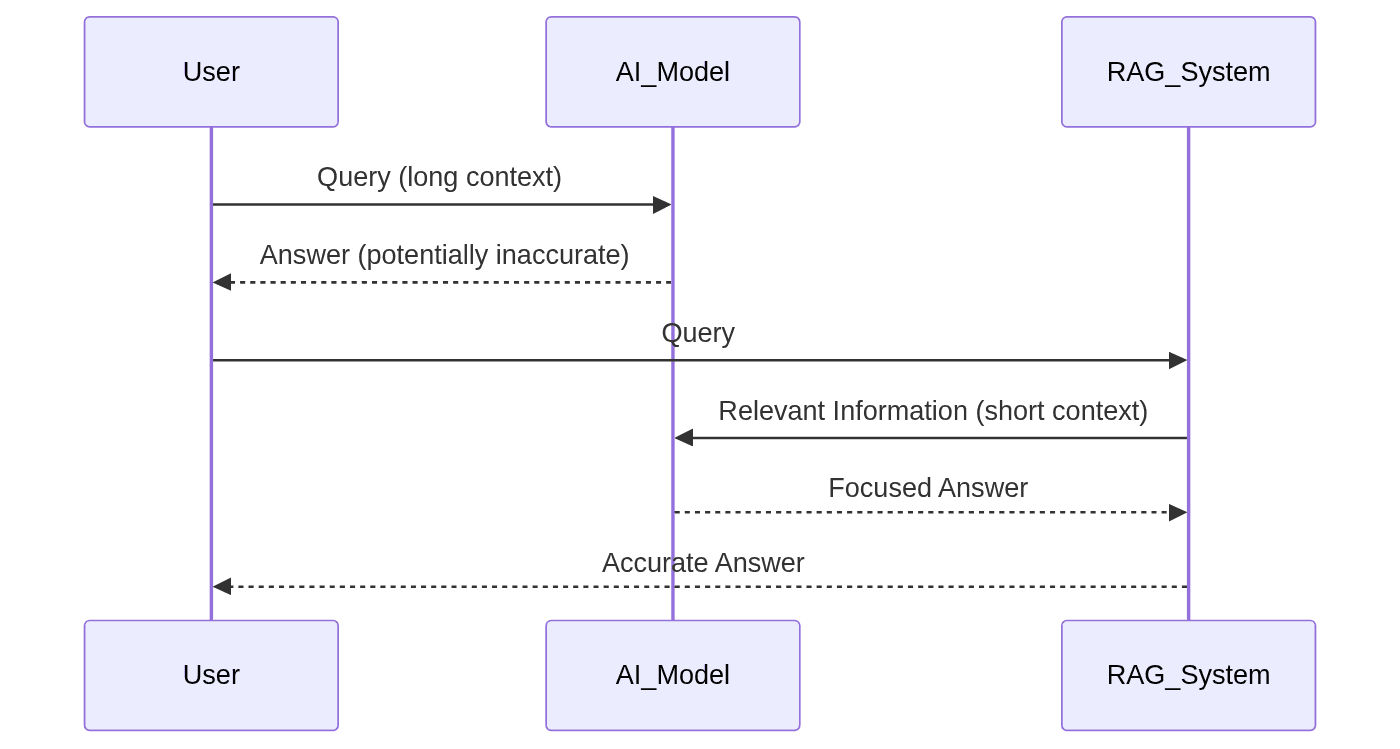
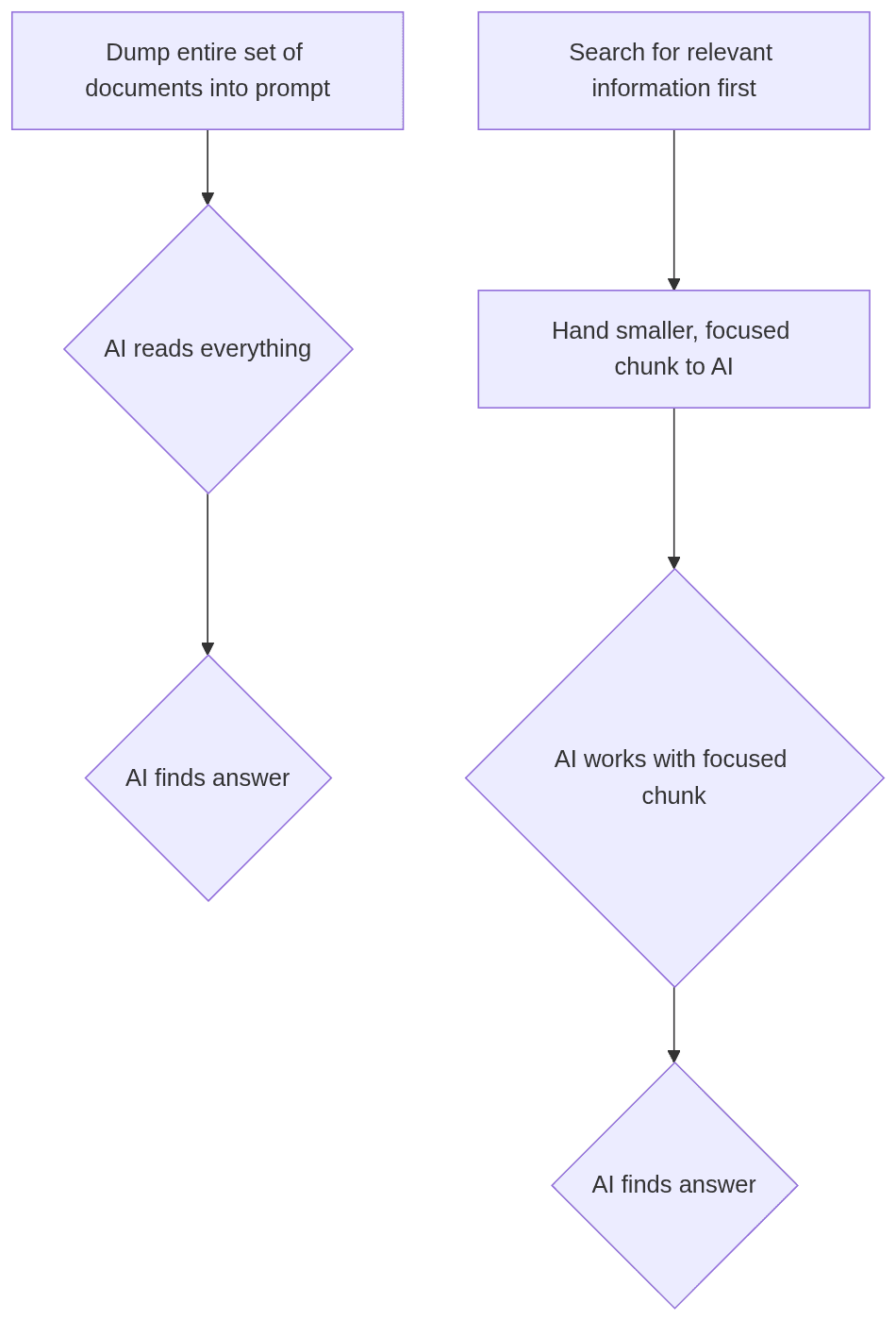
Imagine your company's entire archive is stuffed into one giant filing cabinet, and you need to find a single invoice. One way to do it: hire a junior assistant, hand them the key, and say, "It's in there somewhere. Read everything and bring me the invoice." That assistant will get there eventually, but it'll take a long time, you'll pay them for every minute they spend reading, and there's a real chance they'll get sidetracked by an old memo and forget what they were even looking for. This is roughly how "long-context" AI works: you dump your entire set of documents into the prompt (the text you feed the AI model) and ask it to find the answer itself.
The alternative: hire an expert archivist. You ask for the invoice, they check the index, walk straight to the right drawer, and hand it to you in seconds. This is the idea behind Retrieval-Augmented Generation, or RAG — instead of showing the AI everything, you first search for the relevant piece of information, and only then hand that smaller, focused chunk to the AI to work with.
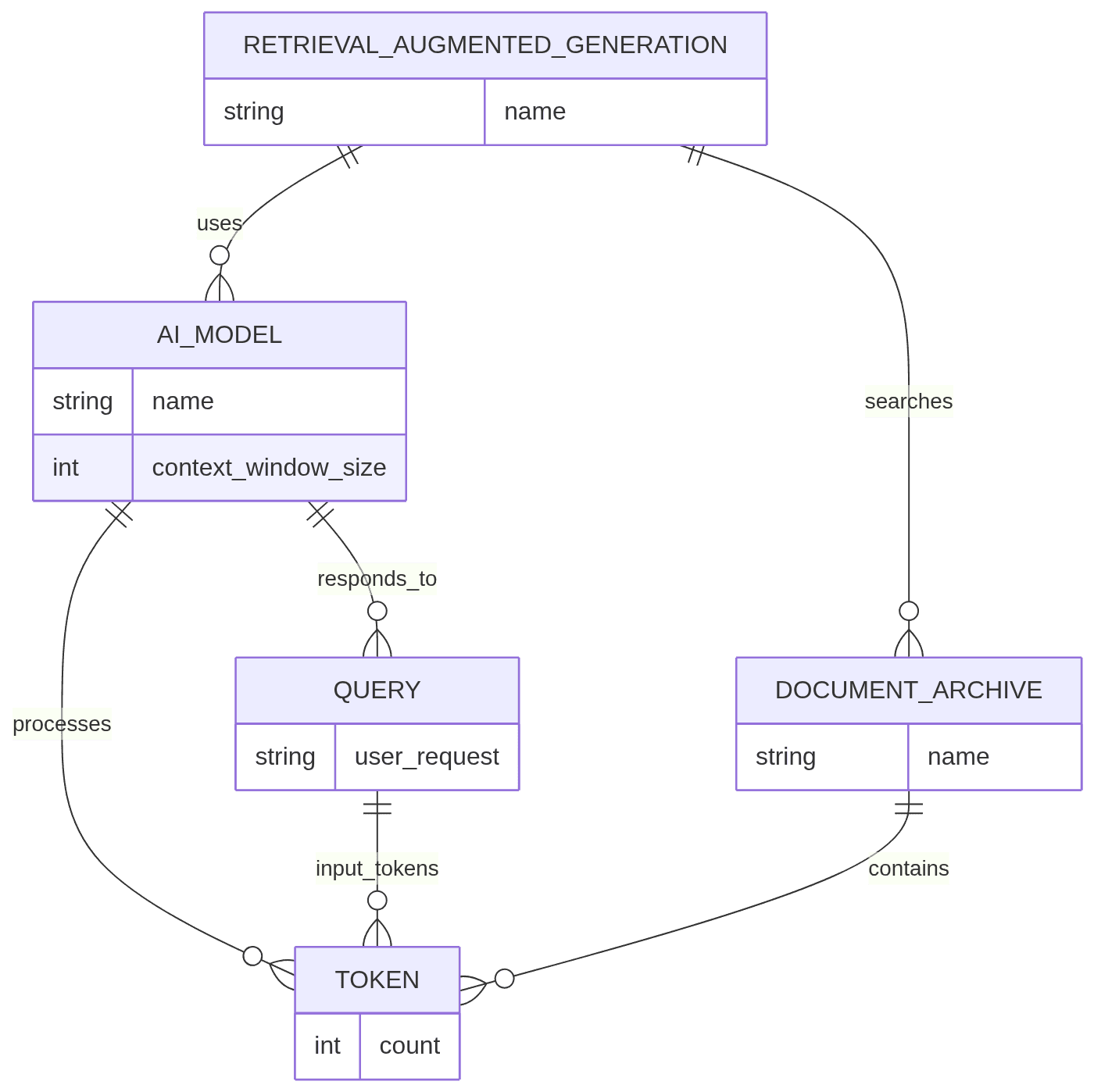
Recently, AI companies have started offering "context windows" — the amount of text a model can take in at once — of up to one million tokens (a token is roughly three-quarters of a word, so a million tokens is around 750,000 words, or about ten novels' worth of text). It's tempting to treat this like getting a bigger filing cabinet for free: just throw everything in and let the AI sort it out.
It doesn't work that way. A bigger context window isn't free storage — it's a budget, and you pay for it in three currencies: money (providers charge per token, so bigger prompts cost more), time (the model has to actually read every token before it can answer, so bigger prompts mean longer waits), and accuracy (the more text you cram in, the easier it is for the model to lose track of the one detail that actually matters). Even the best models available today, when tested on finding one specific fact buried in a million tokens of text, miss it about one time in ten. For a lot of real-world uses — legal document review, medical records, financial audits — that's a failure rate nobody can live with.
How it works
The excitement is understandable. When Anthropic demonstrated that its Claude model could handle a context window of one million tokens, it felt like a fundamental barrier had fallen. A million tokens is about 750,000 words — the equivalent of ten full-length novels or an entire mid-size software codebase, all processed in a single prompt. For developers accustomed to the constraints of 4K or 32K token windows, this was a paradigm shift.
But as the initial hype subsides, the engineering reality sets in. That 1M token capacity isn't a magical space where computation is free. It's a technical achievement that comes with a very real, and very steep, set of trade-offs. To build robust and efficient applications, we need to understand the difference between what a context window can hold and what it should hold.
The Three Kinds of Context Length
The first point of confusion is the term "context length" itself. As researcher Sebastian Raschka notes, the term can refer to three very different quantities, and API providers are usually only advertising one of them.
Configured Context Length: This is the headline number—the 128K or 1M tokens advertised by the model provider. It represents the maximum number of tokens the model's implementation is set up to handle. It's an upper bound, a hard limit on the sequence length you can pass to the API.
Training Context Length: This is the sequence length the model was actually trained on. Models are often pre-trained on a shorter context (e.g., 4K or 8K) and then have their context extended through further fine-tuning on longer sequences. A mismatch between training and inference length can lead to performance degradation, as the model is operating outside the data distribution it knows best.
Effective Context Length: This is the number that actually matters for performance. It's the maximum length over which the model can reliably retrieve and reason about information for a given task. This is almost always smaller than the configured length. A model might accept 1M tokens, but if it can't find a fact buried at token 750,000, its effective context length for that task is less than 750K.
The distinction is crucial. Just because a model with a 128K configured context length can accept a long prompt doesn't mean it will perform well. More importantly, it doesn't mean you pay the cost of 128K tokens for every call. If you send a 2K token prompt to that same model, the attention calculation runs on those 2K tokens, not an imaginary 128K sequence. The cost, in both time and money, scales with what you use, not what you could have used.
The Quadratic Cost of Attention
The primary driver of cost and latency in long-context models is the self-attention mechanism. In a standard Transformer architecture, every token in the input sequence must attend to every other token. This allows the model to understand the relationships between words, no matter how far apart they are.
The computational cost of this operation, however, is brutal. To calculate the attention scores, the model creates a matrix of query-key scores for every pair of tokens. The number of pairs grows with the square of the sequence length, a relationship known as O(n²).
Let's make this concrete. As Sebastian Raschka explains, if you increase your prompt length from 8,000 tokens to 16,000 tokens (a 2x increase), you don't double the number of attention scores. You create about four times as many.
An 8K prompt has roughly 8,000 * 8,000 = 64 million attention pairs per head, per layer.
A 16K prompt has roughly 16,000 * 16,000 = 256 million attention pairs.
This initial processing of the entire prompt is called the prefill stage. It is the most computationally intensive part of an LLM call. While optimizations like FlashAttention are critical — they reduce the memory traffic by avoiding the need to store the entire N x N attention matrix in memory — they still compute the same final attention result. The number of floating-point operations remains quadratic. This is why feeding a model 1M tokens takes a meaningful amount of time before it even begins generating a response.
A Worked Example: Latency, Cost, and the KV Cache
Let's walk through the practical impact of these costs. Imagine you're building a "chat with your code" application. A user wants to know, "What does the calculate_taxes function do?" Your codebase is 500,000 tokens.
Scenario A: The Naive Long-Context Approach
You decide to use a model with a 1M token window. Your prompt looks like this:
System Prompt: 1,000 tokens
User Question: 50 tokens
Entire Codebase: 500,000 tokens
Total Input: 501,050 tokens
Let's assume a hypothetical API pricing of $5.00 per million input tokens.
Monetary Cost: (501,050 / 1,000,000) * $5.00 = $2.51 per query.
Latency Cost: The model must first perform the prefill operation on over half a million tokens, calculating trillions of attention scores. This can take many seconds, or even minutes, during which the user sees a loading spinner. After prefill, the model generates the answer token by token (the decoding phase), and the size of the prompt affects this stage too: the model must keep the intermediate state of all 501,050 tokens (the Key-Value or KV cache) in high-speed GPU memory. A larger KV cache consumes more memory and can slightly slow down each decoding step.
Scenario B: The RAG Approach
You use a retrieval system first. You use a fast, cheap embedding model to identify the single file that contains the calculate_taxes function. That file is 4,000 tokens long. Your prompt now looks like this:
System Prompt: 1,000 tokens
User Question: 50 tokens
Retrieved Code File: 4,000 tokens
Total Input: 5,050 tokens
Monetary Cost: (5,050 / 1,000,000) * $5.00 = $0.025 per query. (Plus a negligible cost for the retrieval step). This is about 100 times cheaper than the naive approach.
Latency Cost: The prefill stage now operates on just ~5K tokens instead of ~500K, so the computation is orders of magnitude smaller and the user gets a response in a fraction of the time. The KV cache is small too, keeping decoding fast and memory usage low.
This is the core trade-off. The 1M token window gives you the option to be naive, but the cost is enormous.
Attention Dilution: The "Lost in the Middle" Problem
The final, and perhaps most insidious, cost is a drop in quality. More context is not always better context. All large language models, regardless of their window size, are susceptible to a phenomenon sometimes called the "lost in the middle" problem.
When you provide a model with a very long prompt that contains a mix of relevant and irrelevant information, the model can struggle to identify the "signal" (the key fact you need) from the "noise" (everything else). Performance tends to be best when the crucial information is placed at the very beginning or the very end of the prompt. When it's buried deep in the middle of a million-token sea of text, the model is more likely to miss it.
Published figures for Claude at 1M tokens are impressive but revealing: roughly 90% retrieval accuracy on "needle-in-a-haystack" tests [1]. This means the model successfully found the target information in 9 out of 10 attempts. But it also means that 1 in 10 queries failed. For many production applications — from legal discovery to medical report analysis — a 10% failure rate is not acceptable. Adding more, irrelevant context can actively hurt model performance, making it more likely to hallucinate or give an incomplete answer.
What this means in practice
The shift from 4K to 1M token windows doesn't eliminate the need for careful application design. It elevates it. The central question for a developer is no longer "Can I fit this in the prompt?" but "What deserves to be in the prompt?"
A 1M token context window is a budget. RAG is a strategy for spending that budget wisely. The correct architectural choice is rarely a binary "RAG vs. Long Context," but a spectrum of hybrid approaches.
For the people building with this:
Your job is now that of an information architect. You must manage a cost-benefit analysis for every token you send to the model.
When to go long: Use a large portion of the context budget when the task requires synthesis across many disparate documents. For example: "Analyze these 500 customer reviews and identify the top three recurring complaints." No single review contains the answer; the model needs a broad view to find the pattern. This is a high-cost, high-value query that justifies the expense.
When to use RAG: Use retrieval when the task is question-answering, where a specific fact exists in your knowledge base. For example: "What is our company's policy on parental leave?" Brute-forcing the entire employee handbook into the prompt is slow, expensive, and less reliable than simply retrieving the relevant section and providing it as focused context.
Start with RAG, expand with context: A powerful pattern is to use RAG as a default and strategically expand the context when needed. If a user's query is ambiguous, a RAG system might pull several potentially relevant documents. Here, a 32K or 128K window is extremely useful for letting the model itself disambiguate from a handful of sources, an approach that was impossible with older 4K models.
For the people who use what they build:
This new reality will change your experience with AI tools, sometimes in non-obvious ways.
Variable Speed: You might notice that asking an AI to summarize a 10-page document is nearly instant, but asking it to analyze a 500-page one causes a long pause. That pause is the prefill latency of a massive prompt.
"I don't recall that": If you're in a very long conversation with a chatbot, you might find it "forgets" a detail you mentioned an hour ago. That detail might have been pushed into the "middle" of the context, where the model's attention is weakest.
The Power of Good Questions: The performance of a system will depend heavily on how well it can guess what context you need. A well-designed RAG system will feel "smarter" and faster than a naive long-context system because it's better at finding the right information before the LLM even sees the question.
Where this is heading
The million-token context window is not the end of the story. It's the beginning of a new chapter in AI engineering, focused on efficiency and reliability at scale.
The available evidence points to a clear trend: configured context windows will continue to grow, but the fundamental trade-offs of compute, memory, latency, and cost will remain. The core challenge is, and will continue to be, closing the gap between the configured context length and the effective context length — that is, between what a model can technically accept and what it can actually pay attention to reliably. A model that could actually use 100% of a 1M token window would change how we build AI applications, but we are not there yet.
Looking forward, my own reading of the field suggests the most interesting developments will be in building smarter, more dynamic context management systems, moving beyond the dichotomy of "pure RAG" vs. "pure long context."
I expect to see more multi-step, hybrid architectures become standard. For example, a "coarse-to-fine" retrieval process: a first, relatively cheap call to a long-context model might scan 500 documents to identify the 5 most relevant ones. A second, highly-focused call would then use those 5 documents to synthesize a precise answer.
The frontier is shifting. For the last two years, the game was about securing access to the model with the biggest context window. Now, the game is about designing the most efficient system to leverage that context. The headline number may be solved, but the engineering challenge has just begun.