

Your metrics are lying to you
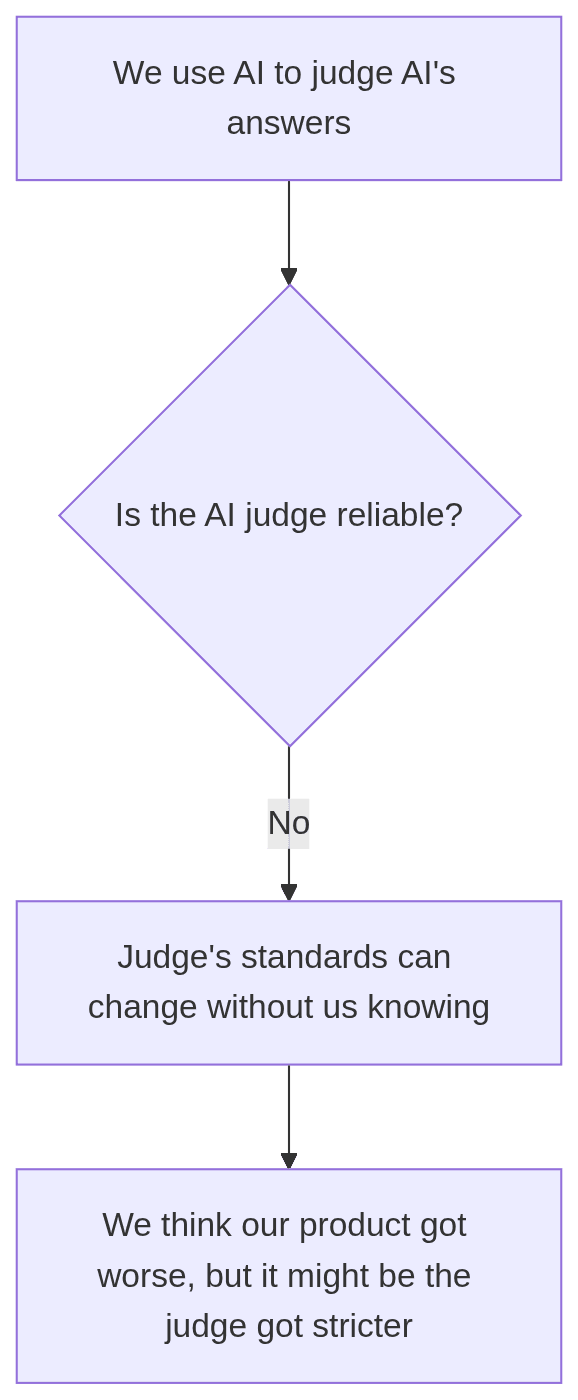
Your AI product's quality score drops 15% overnight. A dashboard that was green yesterday is now red. The on-call engineer scrambles, checking recent code changes and model deployments. But there are none. The application being measured hasn't changed, yet it's suddenly performing worse. How is this possible? The problem isn't your product; it's your judge. The system you use to measure quality isn't a person or a fixed formula — it's another large language model (LLM), given an instruction prompt and asked to score the first model's output. This setup is called "LLM-as-a-judge," and it has quietly become harsher. That's "judge drift": your grading system silently changing its standards while you assume it's holding still.
LLM-as-a-judge is a popular technique precisely because it's cheap and scalable: instead of paying humans to read thousands of chatbot replies and rate them, you have one AI model grade another AI model's answers, using a written scoring guide (a "rubric") baked into the prompt. It works well for exactly the kind of task that resists simple automated checks — judging whether a summary is coherent, or a chatbot reply is genuinely helpful, rather than just checking if the output contains the right keywords or the right data format.
But here's the catch: an LLM judge is a moving part, not a fixed ruler. The company that makes the judge model might quietly update it. Your own team might tweak the rubric to catch mistakes you've noticed. Either change alters how the judge scores things — and both changes look, from the outside, exactly like your product getting worse or better. Without some way to check the judge's behavior against a fixed standard, you have no way to tell whether a falling score means your product broke or your measuring stick just got stricter. Your most important quality metric can quietly become meaningless, and nothing will alert you to it.
The Promise of Automated Judgment
The idea of using an LLM to grade another LLM's output became standard practice for a simple, compelling reason: it works, and it scales. Before this technique, evaluating things like the helpfulness of a chatbot or the coherence of a summary required expensive, slow, manual review by humans. Code-based evaluations could check for structured data or keywords, but they missed the semantic nuance that makes a response good or bad.
The breakthrough came in 2023 with the paper "Judging LLM-as-a-Judge with MT-Bench and Chatbot Arena." Researchers from UC Berkeley, Stanford, and other institutions rigorously tested the concept. They built a challenging benchmark of multi-turn questions (MT-Bench) and a public platform for head-to-head model comparisons (Chatbot Arena). They used GPT-4 as a judge to evaluate other models' answers and compared its verdicts to those of human experts.
The results were stunning: the LLM judge achieved over 80% agreement with the human labelers. Critically, this was about the same level of agreement that two human experts achieved with each other when grading the same response. An LLM could approximate human judgment at a fraction of the cost and time, and the technique exploded in popularity as teams finally got automated feedback on the qualitative aspects of their AI systems.
But the same research that validated the method also highlighted its limitations. The authors identified several systemic biases:
Position Bias: A judge can prefer the first or second response it sees, regardless of content.
Verbosity Bias: A judge can favor longer, more detailed answers, even if they are less correct.
Self-Enhancement Bias: A judge may unfairly favor answers generated by itself or its own model family.
Limited Reasoning: A judge can struggle with complex reasoning, math, or coding problems, making its evaluation unreliable in those domains.
These biases are manageable, but they serve as a crucial reminder: an LLM judge is not an objective oracle. It is a powerful but flawed tool. And its flaws are not static.

The Two Faces of Drift
An LLM judge is not a single thing. It's a system composed of two key components: the language model itself and the prompt that contains the instructions, or rubric, for the evaluation. Both can and will change over time, creating two distinct forms of drift that can invalidate your results.
Model Drift: The Shifting Foundation
Most teams don't host their own judge models. They call a third-party API from a major provider. This is convenient and cost-effective, but it means a critical piece of your evaluation infrastructure is a black box you don't control.
Model providers are constantly updating their flagship models. These updates often fix bugs, improve performance, or add new safety mitigations, and they're almost always announced as straightforward improvements. For an LLM judge, though, "improved" can mean "different in a way that breaks my metrics." A new model version might have a different interpretation of your rubric, a lower tolerance for ambiguity, or a new internal bias.
When your judge model is updated from model-version-04-2025 to model-version-10-2025, its scoring behavior can change subtly. It might start penalizing responses for being too colloquial, even though that was never part of your explicit rubric. Because the model's internal "personality" has shifted, your scores shift with it. A judge that has become stricter will make a perfectly stable application look like it's regressing.
Rubric Drift: The Moving Goalposts
The second source of drift is your own team. As you use an LLM judge, you'll discover edge cases where it fails. You'll find it's too lenient on factual errors or doesn't correctly identify a specific type of hallucination. In response, you will do the sensible thing: you will improve your prompt.
You might add a clause like:
"The response must be grounded in the provided context. If the response includes information not present in the context, assign a score of 1 for 'Groundedness'."
This is a good change. It makes your evaluation more robust and specific to your needs. But it also makes your judge fundamentally stricter. You have moved the goalposts. An answer that would have scored a 9/10 last week now scores a 1/10.
This iterative improvement is essential for building a useful judge, but each change erodes the historical comparability of your metrics. Over months of small, sensible improvements, you can create a judge that is far harsher than the one you started with, making long-term trend analysis impossible.
A Worked Example of Silent Failure
Let's make this concrete. Imagine you run a RAG (Retrieval-Augmented Generation) application that answers questions based on a library of internal documents. Your primary goal is helpfulness. You use an LLM judge to score every production response on a scale of 1-10 for "Helpfulness."
Quarter 1: The Baseline Your initial judge prompt is simple:
You are an expert evaluator. Rate the following response for its helpfulness on a scale of 1-10. A helpful response directly and accurately answers the user's question.

User Question: {{question}}
Response: {{response}}

Score:
In Q1, your application's average Helpfulness score is a solid 8.5/10. The team is happy.
Quarter 2: The Rubric Update The team notices that some highly-rated responses are helpful but invent details not found in the source documents. This is a potential problem. They decide to tighten the rubric.
The new prompt looks like this:
You are an expert evaluator. Rate the following response for its helpfulness on a scale of 1-10. A helpful response directly and accurately answers the user's question USING ONLY the provided context. Penalize any information not found in the context.

User Question: {{question}}
Context: {{context}}
Response: {{response}}

Score:
This is a much better prompt. It aligns the evaluation with a critical business requirement: grounding.
The "Regression" The team deploys the new judge prompt. The next day, the average Helpfulness score for the application has plummeted to 7.2/10. Panic ensues. A flurry of questions follows: Did the last deployment break the retriever? Is the generator model hallucinating more? An investigation begins, consuming days of engineering time.
But the application didn't change. The only thing that changed was the ruler being used to measure it. The 8.5 and the 7.2 are not comparable numbers because they were generated by two different evaluation systems. The drop isn't a signal of a product regression; it's a measurement artifact. Without a way to control for the judge's changing behavior, the team wasted days chasing a ghost in the machine.
How to Calibrate Your Judge
The solution to judge drift is not to stop improving your rubrics or to avoid model updates. The solution is to measure the judge itself. You need a stable, unchanging benchmark to periodically check your judge's behavior. This process is called calibration, and it relies on a "golden set" of human-labeled data.
Following this four-step process turns your LLM judge from an unstable liability into a reliable tool.
Step 1: Forge Your Golden Set
A golden set (or holdout set) is a static collection of inputs and expert-verified outputs that represent a ground truth for your evaluation task. This is your anchor.
Collect Diverse Examples: Sample from your production traffic. Include good examples, bad examples, and, most importantly, tricky edge cases. Capture a wide range of topics and user intents. A good starting point is 100-200 examples. The dataset accompanying the original MT-Bench paper, for instance, contained 3,000 expert votes to ensure robustness.
Define a Stable Rubric (for Humans): Write down the exact criteria a human should use to label the data. This should be the "ideal" version of your evaluation. Be specific. What constitutes a "minor" factual error versus a "major" one?
Label with Experts: Have at least two human experts label the entire set according to the rubric. The goal is not just to get labels, but to refine the rubric itself. Where the experts disagree, discuss the discrepancy and clarify the rubric until they reach a consensus. This process forces you to define what "good" really means.
Lock the Set: Once labeled and finalized, this dataset is immutable. You do not add to it or change the labels. It is the fixed point against which all future judges will be measured.
Step 2: Measure the Agreement
Now that you have a ground truth, you can measure how well your LLM judge aligns with it.
Run your current LLM judge (the specific model version + the specific prompt) against every example in your golden set. Compare the judge's output (e.g., a score of 8/10) with the human label for that same example.
Calculate the agreement rate. For numerical scores, you can use metrics like Pearson correlation or simply measure the percentage of scores that are within a certain tolerance (e.g., +/- 1 point). For categorical labels (e.g., "Hallucination" vs. "No Hallucination"), you can calculate precision, recall, and F1-score.
Your target should be a high level of agreement. As a rule of thumb, aim for 75–90% agreement with your human labels before trusting a judge in an automated system. This range acknowledges that even humans don't agree 100% of the time.
Step 3: Establish a Cadence
Calibration is not a one-time event. It's a recurring process. You don't need to run it on every commit, but you should establish a clear cadence.
Re-calibrate your judge when:
The model provider announces a new version of the model you use for judging.
You make a significant change to your rubric or evaluation prompt.
On a regular schedule, such as quarterly, to detect gradual, unannounced drift.
Store the results of each calibration run. A simple log showing the date, the judge version (model + prompt hash), and the agreement score against the golden set is enough. This log is the key to interpreting your production metrics.
Step 4: Diagnose, Don't Just Measure
This calibration process gives you a new superpower: the ability to diagnose the source of a metric change. Let's revisit our earlier example.
The RAG app's "Helpfulness" score drops from 8.5 to 7.2.
Without Calibration: Panic. Is it the app? Is it the data? Is it the model? Everyone starts guessing.
With Calibration: The on-call engineer follows a simple procedure.
They take the new judge (with the updated prompt) and run it against the golden set.
They find that the judge's agreement with the human labels on the golden set has also changed. The old judge had 88% agreement; the new, stricter judge has 91% agreement (it's better!) but produces systematically lower scores.
Diagnosis: The judge's baseline has shifted. The 7.2 score from the new judge is not comparable to the 8.5 from the old one. The new baseline for "good" is now 7.2. There is no product regression.
The calibration score acts as a control variable.
Production scores drop, calibration score is stable: The judge is behaving consistently. The problem is likely a real regression in your application. Investigate the app.
Production scores drop, calibration score also drops/changes: The judge has drifted. The change in production scores is a measurement artifact. The "regression" is an illusion. You need to re-baseline your expectations.
What This Buys You, and What It Costs
Building a calibration pipeline costs real time: someone has to gather 100-200 example cases, write a precise scoring rubric, get two or more experts to label every case, and hash out their disagreements until the rubric is airtight. Then that discipline has to continue — re-running the golden set every time the judge model updates, every time the prompt changes, and at least once a quarter regardless. None of that is free, and it's easy to skip when a deadline looms.
But skip it, and you're flying blind. Without a fixed benchmark, a quality score dropping from 8.5 to 7.2 is a mystery with no method for solving it — you can't tell a real product regression from a judge that just got stricter, so every dip in the dashboard turns into a multi-day investigation chasing a problem that may not exist. Teams end up distrusting a metric they built specifically to avoid that kind of guesswork, or worse, they trust it anyway and make the wrong call — rolling back a good deployment, or missing a real regression because "the judge probably just changed again."
Calibration replaces that guesswork with a two-line answer: check whether the judge's agreement with your golden set moved. If it didn't, go investigate the application. If it did, re-baseline your expectations and move on. That's the entire payoff — not a fancier dashboard, but the ability to tell measurement noise from a real signal in minutes instead of days, and to keep long-term trend lines meaningful even as both your rubric and the underlying model keep changing under you.
The 80% agreement figure that launched the LLM-as-a-judge approach was a starting point, not a guarantee. It proved the technique was possible. But deploying it reliably in production requires moving beyond that initial promise and building the ongoing habit of checking the checker. Don't just use a judge. Judge your judge.