
Why the pilot lied
Imagine you're a research assistant. Your boss hands you a single, well-organized binder with 200 pages and asks you to find facts inside it. You quickly become an expert, answering every question correctly and fast. Everyone's impressed. This is your RAG pilot — "RAG" stands for Retrieval-Augmented Generation, a fancy way of saying "a search engine hands facts to an AI, and the AI writes the answer." It looks like magic.
Now your boss takes away the binder and instead gives you a key to a warehouse containing 200,000 unsorted, unlabeled, and sometimes contradictory documents. Same kinds of questions, same job. Except now, finding the right page is nearly impossible. You're buried in noise. Half the documents are outdated. Some say completely different things about the same topic. You can't tell which ones matter. Your answers become slow, incomplete, or just plain wrong — even though you're just as smart as before.
That's exactly what happens when a RAG system moves from a tidy demo into messy real-world production. The underlying technology — a search step that fetches relevant text, followed by an AI (a Large Language Model, or LLM) that writes a fluent answer from it — doesn't change. The environment does. The hard part stops being "can the AI summarize nicely" and becomes "can the search step actually find the right needle in an enormous haystack." Your pilot worked because the haystack was small. Your product is struggling because the haystack got 1,000 times bigger, and nobody cleaned it first.
How it works
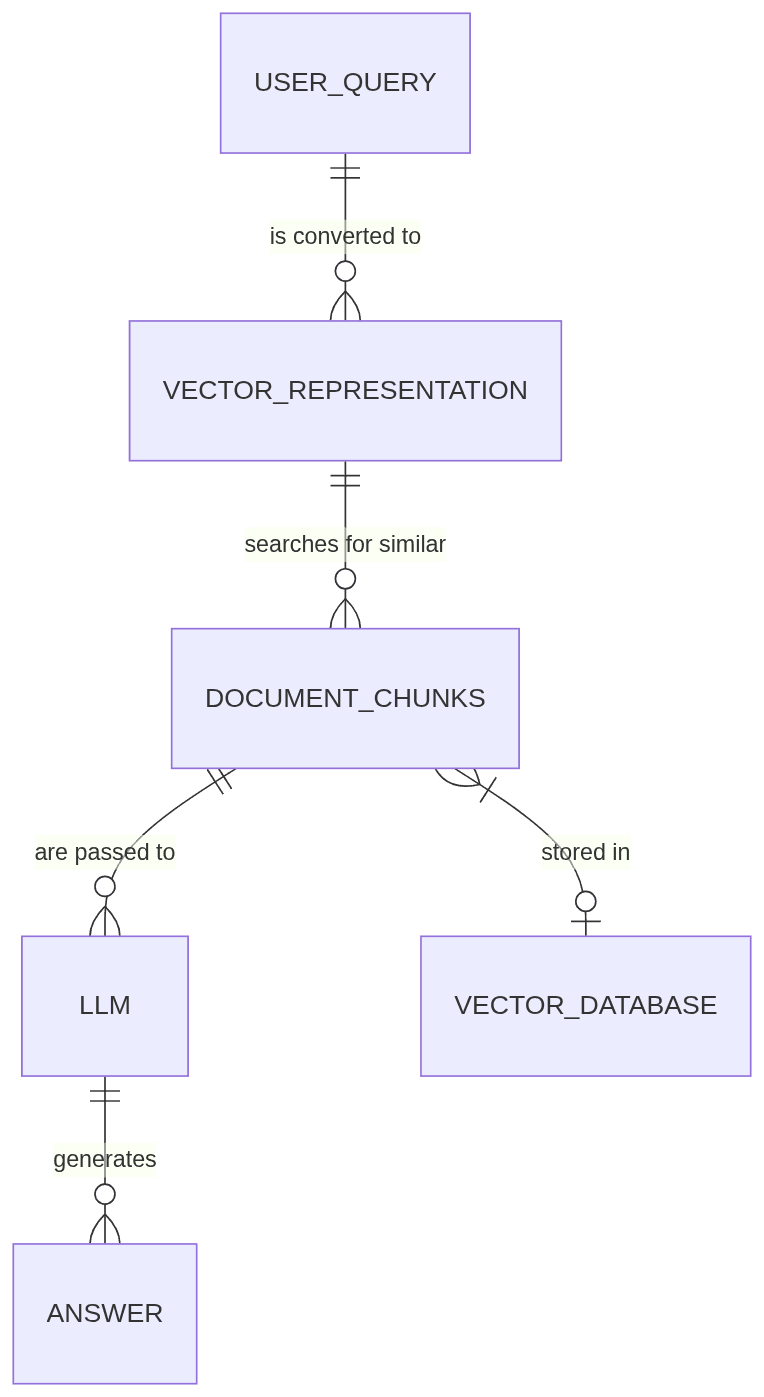
The story is a familiar one. A team builds a chatbot using a "naive" RAG pipeline. It looks simple and effective: take a user query, turn it into a vector (a list of numbers representing its meaning), and use that to find the most similar document chunks in a vector database. Pass those chunks to an LLM, get a beautifully worded, fact-based answer. It works brilliantly on the curated "golden set" of 200 company documents.
Then it hits production. The corpus isn't 200 documents; it's 200,000 emails, reports, and wiki pages. As one engineer recounted, the chatbot that charmed the board suddenly returned "I don't know" to nearly half of all customer queries [5]. Retrieval is usually where it breaks first: a recall@5 of 0.61 would mean the correct document chunk is not in the top five results 39% of the time.
A RAG system is a pipeline, and each stage is a potential point of failure [3].
User Query → Embed Query → Vector Search → Top-K Chunks → LLM → Response
The pilot's success was an illusion because it tested the easiest part: the LLM's ability to generate from clean, relevant context. Production stress-tests the hardest part: the retrieval. Let's break down where the failures happen.
### The Retrieval Problem: Finding a Needle in a Haystack Factory
The core of RAG is a similarity search. In a small, clean dataset, it's likely that the most similar document chunk to your query is also the most relevant. This assumption breaks down at scale.
As you add documents, you add "distractors." For a query like "What is our Q3 revenue forecast?", a 200,000-document corpus might contain:
The actual Q3 forecast document.
The Q2 forecast document.
The Q3 forecast from last year.
Dozens of emails and meeting notes mentioning the Q3 forecast.
Financial models that use forecast numbers as inputs.
From a vector-similarity perspective, all of these are plausible matches. The vector for "Q3 revenue forecast" might be closer to a dense email chain discussing the forecast than to the sparse, formal report containing the actual answer.
This is how recall collapses. Your vector database is no longer retrieving just the right answer; it's retrieving five plausible-sounding but incorrect alternatives. The LLM, given five wrong documents, will confidently synthesize a wrong answer. It's not hallucinating; it's accurately summarizing the faulty context it was given [2]. The retrieval stage has failed, making it impossible for the generation stage to succeed.
### The Corpus Problem: Duplicates, Dirt, and Decay
Production data is not clean. Unlike your curated pilot documents, it is messy in three specific ways that break RAG systems.
1. Near-Duplicates: In a large corporate knowledge base, the same piece of information is often repeated in slightly different forms. A security policy might exist as a formal PDF, a wiki page, a summary slide deck, and a training video transcript. When a user asks a question about that policy, these four documents compete for the top rank. This "splits the vote," lowering the score of each individual document. It's entirely possible that none of them make it into the top-k results your system retrieves, even though the answer is technically present many times over.
2. Stale Content: LLMs have a knowledge cutoff, which is why RAG exists—to provide up-to-date information [3]. But if the RAG system's own knowledge base is out of date, you've just replaced one problem with another. If nobody is responsible for archiving the Q2 2024 sales deck when the Q3 version is published, your RAG system will happily retrieve and present obsolete information. The system can't retrieve what isn't there, but just as dangerously, it will retrieve what is there but shouldn't be [2].
3. Missing Content: Sometimes the answer simply isn't in the knowledge base. A naive RAG system has no way of knowing this. It will retrieve the "least wrong" documents it can find and pass them to the LLM. The LLM, instructed to answer the question based on the provided context, will try its best, often resulting in a vague, hedged response or an outright hallucination [2]. A robust system needs a mechanism to identify when no relevant context is found and respond with "I don't have the information to answer that."
### The Chunking Problem: The Wrong Unit of Work
To make documents searchable, we break them into chunks. This is the most critical and least appreciated step in building a RAG system. A naive strategy, like splitting documents into fixed-size 128-token pieces, is a primary cause of failure [5].
Consider a sentence that spans two chunks: "Our previous strategy focused on market A. Our new strategy, however, will focus on market B."
Chunk 1 ends with: "...focused on market A."
Chunk 2 starts with: "Our new strategy, however..."
A query about the new strategy might only retrieve Chunk 2, which lacks the full context. A query about the old strategy might retrieve Chunk 1, which appears to be current.
The inverse is also a problem. A single chunk could contain a table of financial results followed by legal boilerplate. The embedding for that chunk is a meaningless average of "finance" and "legal," making it a poor match for a specific query about either topic.
Solving this requires more intelligent chunking strategies that respect document structure—paragraphs, sections, tables—and ensure that the semantic "unit" of information remains whole. This is a data processing problem, not an LLM problem.
### The Permissions Problem: Who Gets to See What?
In a real-world enterprise, not everyone is allowed to see everything. The finance department has access to documents the engineering department doesn't, and executives see reports hidden from everyone else.
A simple RAG system is dangerously ignorant of permissions. A vector search retrieves the most relevant documents regardless of who is asking. If you don't build a permissions layer, you will inevitably leak sensitive data.
The naive solution is to retrieve a large number of documents (say, top 50) and then filter them post-retrieval based on the user's access rights. This is slow and inefficient. It also means your effective top-k is variable; if a user only has access to 2 of the top 50 documents, the context passed to the LLM will be sparse and likely insufficient.
A production-grade system must bake permissions into the retrieval process itself, either by indexing data in a way that encodes access levels or by using a multi-stage retrieval process that filters candidates early. This adds complexity that is entirely absent from the "hello world" RAG tutorials.
### The Generation Problem: Lost in Translation
Even if you solve retrieval and deliver the perfect documents to the LLM, the generation stage can still fail. Poorly designed prompts can lead to off-target responses [4].
If your prompt is simply Context: {documents} \n\n Question: {query} \n\n Answer:, the model might struggle. It needs more specific instructions. For example, you might need to add directives like "Answer based only on the provided context. If the answer is not in the context, say 'I don't know'."
You can also use prompt engineering techniques like few-shot learning, where you include a few examples of good question-answer pairs in the prompt to guide the model's response format and tone [4].
Furthermore, the LLM is a static model. It doesn't know the current date or other dynamic information. If a user asks "Is this policy still valid?", the system needs to inject the current date into the prompt so the LLM can compare it to the policy's effective date in the retrieved document [4]. This requires an orchestration layer (like LangChain or LlamaIndex) to dynamically construct the prompt from various data sources, not just the vector database [4].
What this means in practice
The gap between a RAG pilot and a RAG product is the difference between demonstrating a technology and engineering a reliable system. Ignoring that gap has real costs.
For the people building this: Your job is not what you think it is. You are not primarily an "LLM prompter." You are, in practice, a data pipeline and information-retrieval engineer. Your time will go to:
Data Curation: Building processes to clean, de-duplicate, and archive content. This is a data-governance problem that AI teams now have to own, whether they signed up for it or not.
Chunking Strategy: Moving from fixed-size chunks to content-aware chunking that preserves meaning — a classic data-engineering task, not a machine-learning one.
Advanced Retrieval: Building multi-stage retrieval pipelines — a fast but rough first pass (like vector search) followed by a slower, more careful re-ranking step. You'll likely combine keyword search with vector search, since each catches things the other misses.
Evaluation, Evaluation, Evaluation: Moving beyond "does the answer sound good?" to a real dashboard of health metrics for the whole pipeline:
Retrieval quality: Precision, Mean Reciprocal Rank (a measure of how high the right answer ranks), and
recall@k(how often the right document shows up in the top k results). Is the system even finding the right documents?Generation quality: Faithfulness (does the answer contradict its sources?), relevance, and absence of hallucination. Is the AI using the documents honestly?
End-to-end health: Latency, cost per query, and user satisfaction. Is the whole thing fast enough and actually useful?
A pilot measures your best day. A production system has to be judged by its worst one.
For the people using what gets built: A naive RAG system doesn't fail loudly — it fails quietly. It doesn't crash; it just becomes subtly, frustratingly useless. It gives confidently wrong answers. It misses information you know is in there somewhere. It cites a three-year-old document as if it were current. Users don't abandon the tool because of one big blowup — they abandon it after a slow accumulation of small disappointments. The chatbot that was supposed to transform internal support quietly becomes the thing nobody trusts anymore.
Where this is heading
The realization that naive RAG is a dead end is pushing the industry toward more robust and complex architectures. This isn't a sign that RAG is a failed idea, but that it is maturing from a simple trick into a serious engineering discipline [5].
The clear trend across these sources is this: the "retrieval" step is splitting apart into a multi-stage process. Instead of one vector search doing all the work, production systems increasingly chain together filtering, hybrid keyword-plus-vector search, and multiple rounds of re-ranking. The logic is simple — spend the extra computing effort making sure the handful of documents that actually reach the AI are the best possible ones, because that's the single highest-leverage point in the whole pipeline. Orchestration frameworks like LlamaIndex and LangChain are becoming the standard toolkits for wiring these more complex systems together [4].
My own reading of this trend is that two separate fields are colliding: the decades-old, rules-based world of classical Information Retrieval (think library-catalog-style search), and the newer world of neural, meaning-based vector search. The future of RAG isn't "vectors or keywords" — it's "vectors and keywords." It's not "one giant index" — it's layered indices and graph-like webs of related documents working together.
Expect a much deeper focus on the data itself. Teams will be forced to fix their underlying knowledge-management problems — the stale documents, the duplicates, the lack of anyone responsible for keeping things tidy — because the AI is now exposing exactly how expensive that chaos really is. The most successful RAG deployments won't come from the teams with the flashiest AI model, but from the teams with the cleanest data and the most rigorous habit of measuring their own system's failures. The job title may be "AI Engineer," but the actual work — as it usually does — comes down to building something reliable, measurable, and worth trusting.