

The Silent Failure Behind a 200 OK
Your monitoring dashboards light up: your main AI provider — the company whose servers actually run the large language model (LLM) behind your chatbot — is having a bad day, and its API (the programming interface your app uses to send requests and get answers back) starts failing. You planned for this. Your system automatically switches traffic to a backup provider, the request goes through, and a valid reply comes back to the user. The HTTP status code — the short number servers use to say "it worked" — reads 200. Every health check, the automated ping that confirms a system is alive, reports green. By every conventional measure, your system just proved it's resilient.
There's one problem: the user, three exchanges into a detailed conversation with the chatbot, has to start over. The chatbot is now running on a different provider's infrastructure, and it has no memory of anything said moments ago. Call it failover amnesia — the system survived the outage, but the conversation didn't.
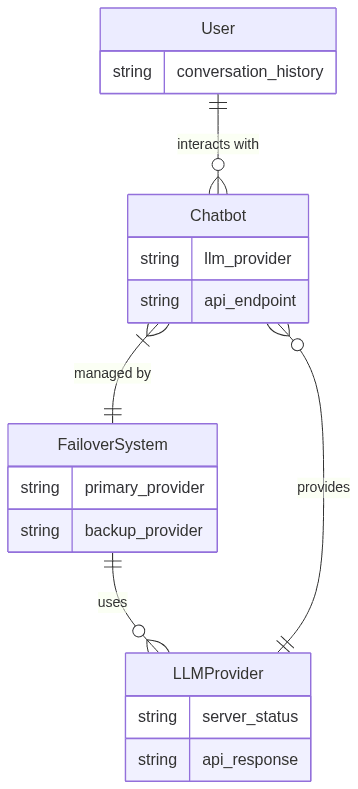
This silent failure is becoming one of the most jarring user-experience problems in production AI. Teams build careful failover logic — automatic backup plans that kick in when a primary system fails — to keep their service technically online. But in doing so, they often lose the one thing that makes a chatbot feel intelligent: its memory of what you just told it. Staying online isn't the same as staying coherent, and this article is about the difference — and how to close the gap.
The Many Faces of Failure
Before we can solve for failover, we need to understand that not all failures are created equal. When we say a provider is "down," it can mean several different things, and a robust system needs a different strategy for each. Relying on a single provider means their worst day becomes your worst day — their failure modes become your failure modes.
Here are the common ways an LLM API call can fail:
Hard Errors (5xx): This is the classic outage. The provider's servers return a
500 Internal Server Erroror503 Service Unavailable. The cause could be anything from a deployment bug to a regional datacenter issue. The correct response is usually to retry once or twice, then fail over to a different provider or a different model from the same provider in another region.Rate Limits (429): This isn't a failure of the provider's service, but a failure to stay within your usage quota. You've sent too many requests in a given time window. A naive response — retrying immediately — is the worst thing you can do. It only adds to the request volume, guaranteeing more rate-limiting in a cycle sometimes called a "thundering herd." The correct response is to pause, respect the
Retry-Afterheader if the provider sends one, and implement an exponential backoff strategy to give the quota window time to reset.Latency Spikes (Brownouts): This is the most insidious failure. The API doesn't fail; it just gets slow. A request that usually takes two seconds now takes twenty. This can be worse than a hard error, as it ties up connections and resources in your own application, potentially causing a cascading failure. A simple timeout might be too blunt an instrument. This is where more sophisticated patterns like circuit breakers or hedged requests (sending the same request to two providers and using whichever comes back first) become necessary.
Content Filter Rejections: The model refuses to respond because the prompt or the generated output tripped its safety filters. This is not a transient technical failure and should not be handled with a retry or failover. Retrying the same prompt will likely get the same rejection. This class of failure needs to be routed to a separate workflow for review or remediation, not treated as an infrastructure problem.
A resilient system must be able to distinguish between these cases. A central routing layer, or gateway, is the natural place for this logic to live, since it sees every request and can make an informed decision instead of leaving that decision to every individual client application.
The Abstraction Layer That Prevents a Rewrite
If your application code contains the line import openai or from anthropic import Anthropic, your resilience strategy is already compromised. Tying your application directly to a specific provider's SDK means that changing providers — whether for cost, performance, or during an outage — requires a code change, a new deployment, and all the risk that entails.
The architectural pattern to prevent this is provider abstraction. You create a stable internal interface for your AI capabilities and hide the provider-specific implementation details behind it. Your application makes a call to your own internal "completions" endpoint, and that endpoint — often a service called an AI Gateway — handles the logic of which provider to call, how to format the request, and how to parse the response.
This is more than just a simple API wrapper. A robust abstraction layer is a control boundary. It lets you:
Swap providers without changing the application. During an outage or a contract negotiation, you can change the routing rules in the gateway, and the consuming application is none the wiser.
Centralize credentials and logging. The application doesn't need to handle raw API keys, which is a significant security improvement. All requests go through one place, giving you a consistent audit trail.
Enforce policy. You can implement caching, rate limiting, and access control for all your LLM usage in one place.
Building this layer introduces its own complexity and a small amount of latency. But as software architect Neal Ford discusses in his talks on modern trade-off analysis, we are always balancing competing architectural characteristics. In this case, we are trading a little performance and simplicity for a massive gain in resilience and portability. For any serious production workload, that trade-off is almost always worth it.
The Hard Part: Bringing the History With You
An abstraction layer makes it possible to switch providers. But doing it without causing amnesia requires that the abstraction layer be stateful. The gateway can't just forward a single, stateless request. It needs to understand the concept of a conversation.
The State-Loss Catastrophe
Let's revisit the chatbot that forgets everything. A standard, stateless failover looks like this:
User sends message "C".
Application constructs a request with the full history:
[User: A, Bot: B, User: C].The gateway tries to send this to the primary provider.
The primary provider returns a
503 Service Unavailable.The gateway retries the exact same request to the secondary provider.
This seems like it should work. The problem is that "the exact same request" is formatted for the primary provider. Different providers have different expectations for how a conversation history should be structured. Some use a list of objects with role and content fields. Others might use a single string with User: and Assistant: prefixes. A model fine-tuned on one format may perform poorly or fail entirely if it receives another.
Furthermore, if the failure happens mid-stream while a response is being generated, the problem is even harder. The user may have already seen the first half of a sentence from the primary model. Do you try to have the second model complete the sentence? Or do you start over?
A truly resilient system must anticipate this.
A Worked Example: Rebuilding the Conversation
A stateful gateway solves the amnesia problem by acting as the canonical source of truth for the conversation history. It stores a normalized, provider-agnostic representation of the conversation and uses it to rebuild the provider-specific payload for every single call.
Here's how the stateful failover works:
Normal Operation:
The user sends their first message: "What are the top three science fiction books from the 1980s?"
The gateway receives this, assigns a conversation ID, and stores the message:
{ "conv_id": "xyz", "history": [{"role": "user", "content": "..."}] }.It formats this history for the primary provider (let's call it
Provider-A) and sends the request.Provider-Aresponds. The gateway adds the response to its stored history:{ "conv_id": "xyz", "history": [..., {"role": "assistant", "content": "..."}] }.The response is forwarded to the user.
Failure and Stateful Failover:
The user sends a follow-up: "Tell me more about the first one."
The gateway appends this to its stored history for conversation
xyz.It attempts to send the full,
Provider-A-formatted history toProvider-A, but receives a503error.The gateway's routing logic decides to fail over to
Provider-B.This is the crucial step: Instead of forwarding the failed request payload, the gateway goes back to its own provider-agnostic history for conversation
xyz. It then runs a translation function that rebuilds the entire conversation payload specifically forProvider-B's API format.The new, correctly formatted request is sent to
Provider-B.Provider-Breturns a valid response, having received the full context of the conversation. The user experiences a seamless continuation, perhaps with a slight delay.
This state-forwarding strategy is the key to defeating failover amnesia. The gateway becomes the single source of truth for conversational state, allowing it to reconstruct context for any downstream provider on demand.
Beyond API Schemas: The Behavioral Mismatch
Even with perfect state reconstruction, failover is not free. You've swapped one model for another, and no two models are identical. The same prompt sent to two different top-tier models can yield different results. This behavioral variance is a major challenge.
Prompt Sensitivity: Prompts are often carefully engineered to work around the quirks of a specific model. A system prompt that produces reliable JSON output on your primary model might be ignored or misinterpreted by your fallback model.
Refusal Behavior: One model might be more conservative and refuse to answer borderline prompts that another model would handle without issue. A user might find their conversation abruptly halted by the new model's safety system.
Tool-Calling and Structured Output: If you rely on models to generate structured data (like JSON) or to call external tools, the syntax and reliability of these features can differ significantly between providers. A failover could break the automation that depends on this structured output.
There is no magic bullet for this. The only solution is to test. Your fallback paths are part of your application's core logic, and they must be validated just as rigorously as your primary path.
How to Test a Path You Rarely Use
This raises a difficult question: how do you test a failover path that, if you're lucky, might only be executed for a few minutes twice a year? Leaving it untested until a real outage is a recipe for disaster.
This is a solved problem in the world of site reliability engineering (SRE), and we can borrow their playbook.
Traffic Shadowing: This is a powerful, low-risk technique. The gateway processes a production request using the primary provider as usual. But in the background, it also sends a copy of the same request to the fallback provider. The fallback's response is logged and compared to the primary's, but never sent to the user. This lets you constantly evaluate the performance, cost, and quality of your fallback path on real production traffic without any user impact. You can build dashboards to track the semantic drift between the two providers and get early warnings if your fallback model's behavior starts to diverge.
Forced Failovers (Chaos Engineering): In your staging or pre-production environment, you must regularly and automatically simulate provider failures. Configure your gateway to randomly fail a certain percentage of requests to the primary provider, forcing the failover logic to engage. This turns an exceptional circumstance into a routine, well-exercised code path. It ensures that your state-forwarding logic works, that your API format translation is correct, and that your team knows how to debug a failover event.
Active Health Checks and Probing: The gateway shouldn't wait for a request to fail to learn that a provider is down. It should be actively sending simple, synthetic requests (like "say 'hello'") to all configured endpoints every few seconds. If an endpoint fails its health check, the gateway can proactively route traffic away from it before a user-facing request fails, reducing the latency impact of an outage.
Resilience Is More Than a Green Light
Building genuinely resilient AI systems means looking past the simple green light on an uptime dashboard. A 200 OK response that arrives with a side of amnesia is a failure wearing a disguise — it just shows up in the user-experience column instead of the error-log column.
The fix is an architecture of stateful abstraction: a gateway that sits between your application and your providers, holds the conversation's real history, and rebuilds it correctly no matter which provider ends up answering. Get this right, and a provider outage becomes invisible to users — the conversation just continues, maybe a beat slower. Get it wrong, and every failover event quietly resets your users to a blank slate, no matter how good your uptime numbers look.
What's still unresolved is the behavioral gap between providers: even with perfect history reconstruction, a fallback model can refuse a prompt the primary one answered, or mangle a structured output your automation depends on. That gap can't be engineered away with better plumbing — it has to be tested continuously, with shadow traffic and forced failovers, so you find the mismatches before your users do. Teams that treat their fallback path as a rarely-used emergency exit, rather than a routine, exercised piece of the system, are the ones who get surprised on the day it matters.