

You're Not Upgrading; You're Gambling
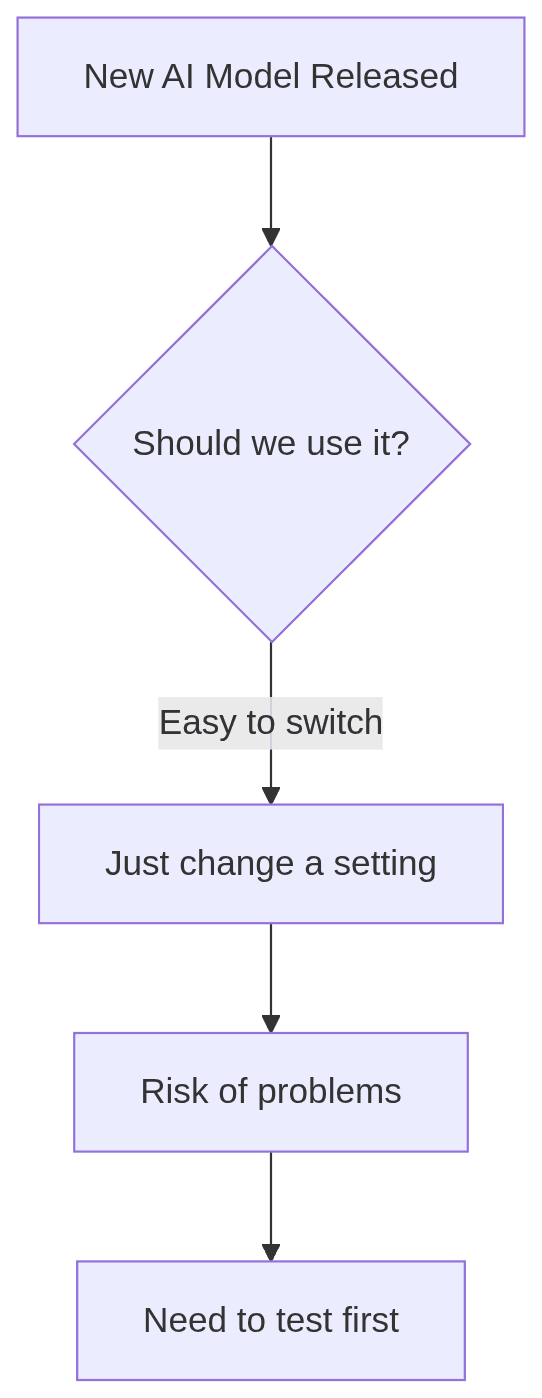
Anthropic released Claude Opus 4.8 on May 28, 2026, without a blog post, a paper, or a single published benchmark. Within days, teams running AI products were already asking the obvious question: should we switch our app over to the new model? For an API-based service, switching can be as easy as changing one line of text in a configuration file — the "model ID" that tells your code which version of Claude to call. Because it's so easy to type, the default answer is usually "yes, right now — it's presumably better."
That impulse is a mistake. A model upgrade isn't like updating a code library to patch a bug; it changes the actual reasoning and output behavior at the core of your application. Swap in a new model without checking it first, and you risk subtle, costly regressions — places where the app quietly gets worse at something it used to do well — surfacing in production, not on a benchmark chart. Before you touch that model string, you need a process: measure the new model against your own tasks, run it safely alongside real traffic without letting it touch users yet (a technique called "shadow mode"), and decide in advance what "better" actually means for your users and your budget. Skip that process and you're not upgrading. You're gambling.
What We Know About Opus 4.8: The Ghost in the Tools
As of this writing, a week after its release, there is no official announcement, blog post, or technical paper for Claude Opus 4.8 from Anthropic. There are no published benchmarks, no latency figures, and no release notes detailing what has changed. All evidence of its existence is circumstantial, found in the documentation of third-party tools that have already started integrating it.
This lack of official data is the central challenge of the upgrade decision. It's also a sign of a maturing ecosystem where toolmakers and power users get access to new models and immediately put them to work. By looking at how they are using Opus 4.8, we can infer its expected strengths, even without hard numbers.
The most prominent sightings are in open-source projects on GitHub:
High-Fidelity Generation: The
baoyu-designproject, which packages Claude's design capabilities into a local tool for creating UI mockups and prototypes, notes that it works "Best with Opus 4.8". This suggests the model has advanced capabilities for generating structured, high-quality artifacts like HTML and CSS from natural language prompts.Advanced Reasoning and Synthesis: A project called
fusion-fableuses Opus 4.8 as the final "judge" in a complex pipeline. This tool sends the same prompt to multiple other models (including, potentially, another instance of Opus 4.8) and then uses Opus 4.8 to synthesize their outputs, identify consensus and contradictions, and write a final, superior answer. The choice of Opus 4.8 for the most critical reasoning step — synthesis — implies its developers believe it has state-of-the-art analytical capabilities.Cloud and Desktop Availability: An AWS Samples repository for a native macOS client for Amazon Bedrock lists Claude Opus 4.8 as an accessible model. This confirms the model is available on at least one major cloud provider, making it viable for production workloads.
Agentic Coding: The
mythos-routerCLI, a tool for AI-assisted coding, claims to leverage "adaptive Claude Opus 4.8 thinking". This points towards strong performance in code generation and tool-use contexts.
The community's adoption pattern paints a picture of a high-capability model excelling at reasoning, synthesis, and complex generation tasks. However, these are just clues. They are not data. A recommendation in a README file is not a substitute for a rigorous, internal evaluation. The absence of official information forces a crucial shift in mindset: you cannot depend on the vendor's marketing; you must become the source of truth for your own use case.

The Upgrade Calculus: Why a Point Release is a Project
Changing "claude-opus-4.7" to "claude-opus-4.8" in your code is a one-line change. The work required to do that safely is a multi-week project. Point releases feel deceptively simple, but they carry hidden costs and risks that are easy to underestimate.
The Cost of Re-validation
Before you can even decide if Opus 4.8 is better, you must invest engineering time to build the infrastructure to measure it. This is a non-trivial cost.
Evaluation Harness: You need a systematic way to run prompts through both the old and new models and compare their outputs. This means building or configuring a testing harness that can manage API calls, handle rate limits, store results, and present them for analysis.
Golden Datasets: You need a high-quality set of test cases. These are prompts that represent your most common use cases, your most valuable edge cases, and known failure modes of your current system. Creating and maintaining this "golden set" requires domain expertise and ongoing effort.
Engineering Hours: Someone has to do this work. A senior engineer spending two weeks setting up evals, running tests, and analyzing results is a significant cost. That's time they are not spending on building new features.
This work is an investment. Once built, this evaluation framework can be reused for every subsequent model upgrade, turning a chaotic scramble into a repeatable process.
The Risk of Silent Regression
The most dangerous failure mode of a model upgrade is not a catastrophic crash; it's a subtle degradation of quality. The new model might be "smarter" on average according to standard benchmarks, but worse on the specific, narrow tasks that your product depends on.
Consider a system that extracts structured data from legal documents. Your prompts have been meticulously engineered over months to handle the specific jargon and formatting of your target documents. A new model, trained on a different data mix, might lose some of that niche capability. It might start formatting dates differently, misinterpreting a key clause it used to understand, or becoming more verbose in a way that breaks a downstream parser.
These regressions are silent because the application doesn't throw an error. It just returns a slightly worse, or outright wrong, answer. If you aren't explicitly testing for them, these issues will only surface as customer complaints, churn, or a slow erosion of trust. A point release that scores 5% higher on MMLU but breaks your core feature is a net loss.
A Framework for Qualifying Opus 4.8
To make a confident upgrade decision, you need to generate your own data. The goal is to compare the new model (the "candidate") against your current production model (the "challenger") in a real-world setting, without exposing users to risk. This framework consists of three phases: shadowing, measuring, and deciding.
Step 1: Shadowing in Production
The most reliable data comes from your own users and your own traffic. A shadow deployment is a technique for testing a new component with live production traffic without affecting the user experience.
The concept is simple: for a fraction of incoming requests, you send the prompt to both your current production model and the new candidate model in parallel. The response from the production model is returned to the user as normal. The response from the candidate model is discarded from the user's perspective but logged alongside the production response for later analysis.
Here is a conceptual diagram of a service proxy that implements shadowing:
User Request (Prompt)
       │
       ▼
┌──────────────────┐
│   Service Proxy  │
└──────────────────┘
       │
       ├───────────▶ ┌──────────────────────┐
       │             │ Production Model     │  ───▶ Response to User
       │             │ (e.g., Opus 4.7)     │
       │             └──────────────────────┘
       │
       └─(shadow)──▶ ┌──────────────────────┐
                     │ Candidate Model      │  ───▶ Logged for Analysis
                     │ (e.g., Opus 4.8)     │
                     └──────────────────────┘
This setup gives you a high-fidelity, side-by-side comparison of how both models perform on the exact same inputs, under real-world conditions.
Implementing this requires a proxy or middleware layer in your application. In a simplified web service, it might look something like this:
# A conceptual example of a shadow proxy in a Python service.
# In a real system, use async requests or a task queue for the shadow call.

import threading
import json
import your_logging_service
import your_anthropic_client

PROD_MODEL_ID = "claude-opus-4.7"      # Hypothetical previous version
CANDIDATE_MODEL_ID = "claude-opus-4.8" # The new version we are testing

def handle_request(prompt):
    # The production call is blocking and its result is returned.
    production_response = your_anthropic_client.messages.create(
        model=PROD_MODEL_ID,
        messages=[{"role": "user", "content": prompt}]
    )

    # The shadow call runs in a background thread to avoid delaying the user.
    # Its result is not returned, only logged.
    shadow_thread = threading.Thread(
        target=run_and_log_shadow_call,
        args=(prompt, production_response)
    )
    shadow_thread.start()

    return production_response.content

def run_and_log_shadow_call(prompt, production_response):
    try:
        candidate_response = your_anthropic_client.messages.create(
            model=CANDIDATE_MODEL_ID,
            messages=[{"role": "user", "content": prompt}]
        )

        # Log everything needed for a side-by-side comparison.
        log_payload = {
            "prompt": prompt,
            "production_model": PROD_MODEL_ID,
            "production_output": production_response.content,
            "production_latency_ms": production_response.latency_ms,
            "production_input_tokens": production_response.usage.input_tokens,
            "production_output_tokens": production_response.usage.output_tokens,
            "candidate_model": CANDIDATE_MODEL_ID,
            "candidate_output": candidate_response.content,
            "candidate_latency_ms": candidate_response.latency_ms,
            "candidate_input_tokens": candidate_response.usage.input_tokens,
            "candidate_output_tokens": candidate_response.usage.output_tokens,
        }
        your_logging_service.log("model_comparison", log_payload)

    except Exception as e:
        # Also log errors from the candidate model.
        your_logging_service.log_error("candidate_model_failure", {"error": str(e)})
This approach allows you to collect thousands or millions of paired responses, forming a rich dataset for the next step.
Step 2: Defining and Measuring "Better"
With a stream of paired responses, you can now measure performance. It is critical to define your metrics before you start the analysis. "Better" is subjective; your goal is to make it objective.
Your metrics should cover four areas: quality, cost, latency, and regressions.
Quality: This is the most important and the hardest to measure.
Automated Evals: For tasks that produce structured output (e.g., JSON, XML) or code, you can create automated checks. Does the output parse correctly? Does the generated code pass unit tests? Does the summary contain the required entities? These checks are fast and scalable but only cover syntactic correctness, not semantic quality.
Model-Based Evals: You can use another powerful LLM (even Opus 4.8 itself) to act as a judge. Given the prompt and the two responses (A and B, anonymized), the judge model is asked to score them on a rubric (e.g., "Which response is more helpful? Which is more factually correct?"). This is surprisingly effective and scalable but can be prone to biases (e.g., preferring a certain style or length).
Human Evals: This is the gold standard. A human reviewer looks at the two responses side-by-side and makes a judgment based on a clear rubric. This is slow and expensive but provides the most accurate signal. You don't need to review every response; a statistically significant random sample is often enough.
Cost: A model upgrade should ideally not increase your operating costs.
Token Consumption: Log the prompt and completion tokens for both models from every shadow call. Is Opus 4.8 more or less verbose for the same task? A model that produces longer answers can drive up your bill even if the price per token is the same. Calculate the average cost per call for both models.
Latency: Speed is a feature.
Time to First Token (TTFT): For streaming use cases, how long does the user wait before seeing the first word? This is a key measure of perceived performance.
Total Generation Time: How long does the entire response take? A slower model might frustrate users or cause timeouts in downstream systems. Measure the distribution of latencies (p50, p90, p99) to understand the worst-case performance.
Regressions: This measures how often the new model fails on tasks the old model handled correctly.
Golden Set Failure Rate: Run your curated golden set of prompts through both models. For each prompt, you should have a known-good output or a set of criteria for success. Any failure by Opus 4.8 on a test that the previous model passed is a regression. A high regression rate is a major red flag.
Step 3: The Go/No-Go Decision
After a week or two of shadowing and analysis, you will have a scorecard for Opus 4.8 on your specific workload. The final step is to make a business decision.
This should not be a gut feeling. It should be based on criteria you defined before the test began. A good decision framework looks like a set of conditions:
We will migrate to Claude Opus 4.8 if, and only if:
The human preference score shows a statistically significant win for Opus 4.8 in at least 60% of sampled cases, with no more than 10% preferring the old model.
The regression rate on our golden set is less than 1%.
The average cost per query increases by no more than 5%.
The p90 total latency increases by no more than 100ms.
The specific numbers will depend on your product's requirements. A chatbot can tolerate higher latency than a real-time data extraction pipeline. The key is to have the discussion and write down the criteria ahead of time.
If the new model meets the criteria, you can proceed with a full rollout, confident that the decision is backed by data. If it doesn't, you stick with your current model and file the analysis away. You have successfully avoided a costly mistake and have a robust framework ready for the next release, whether it's Opus 4.9 or Opus 5.
What We Still Don't Know
Everything above helps you find out how Opus 4.8 handles the work you already ask Claude to do. It won't tell you about capabilities the model has that your current tests never think to check for. As of today, based only on what's visible in public repositories, here's what's still missing:
No official benchmarks: Anthropic hasn't published scores comparing Opus 4.8 to other models on standard tests like MMLU (a broad knowledge-and-reasoning exam), HumanEval (a coding test), or MT-Bench (a conversation-quality test) — so there's no independent way to size up its raw ability against competitors.
No official performance data: No vendor-supplied numbers on latency, throughput, or cost per token.
No feature specifications: We don't know if the context window (how much text the model can consider at once) has grown, whether tool-use or function-calling has improved, or whether new input types are supported.
No release notes: We don't know what the model was tuned for — safety, factual accuracy, a particular language, coding — and that context matters for interpreting why it behaves the way it does.
This vacuum makes the core point of this piece unavoidable: in the absence of vendor data, you have to generate your own. Trusting community chatter and the "newer must be better" assumption isn't an engineering strategy — it's how production incidents get made. Upgrade on purpose, with your own evidence in hand, or don't upgrade at all.