

Your next model choice is a workload choice
In late November 2025, two AI labs released their best models within a week of each other. Google shipped Gemini 3 Pro on November 18. Six days later, on November 24, Anthropic launched Claude Opus 4.5. Both are "frontier" models — industry shorthand for the most capable systems available at a given moment — and both are built for a specific new kind of job: acting as agents. That means they don't just answer questions in a chat window; they carry out multi-step tasks on their own, reading through large amounts of information and taking action without a human checking every step.
That shift changes the question engineers and product leaders need to ask. It used to be "which model is smartest?" Now it's "which model fits the specific kind of work I need done?"
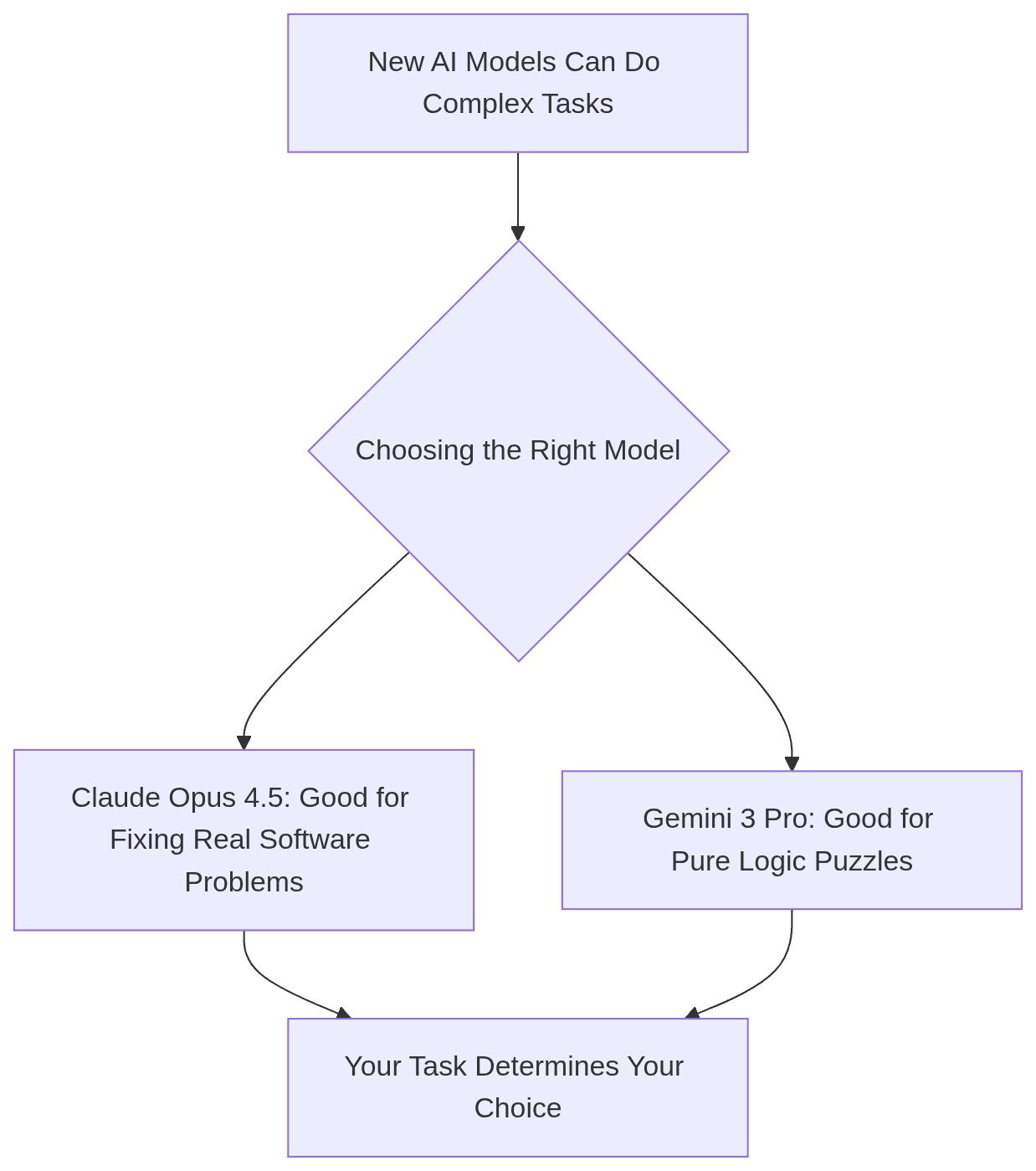
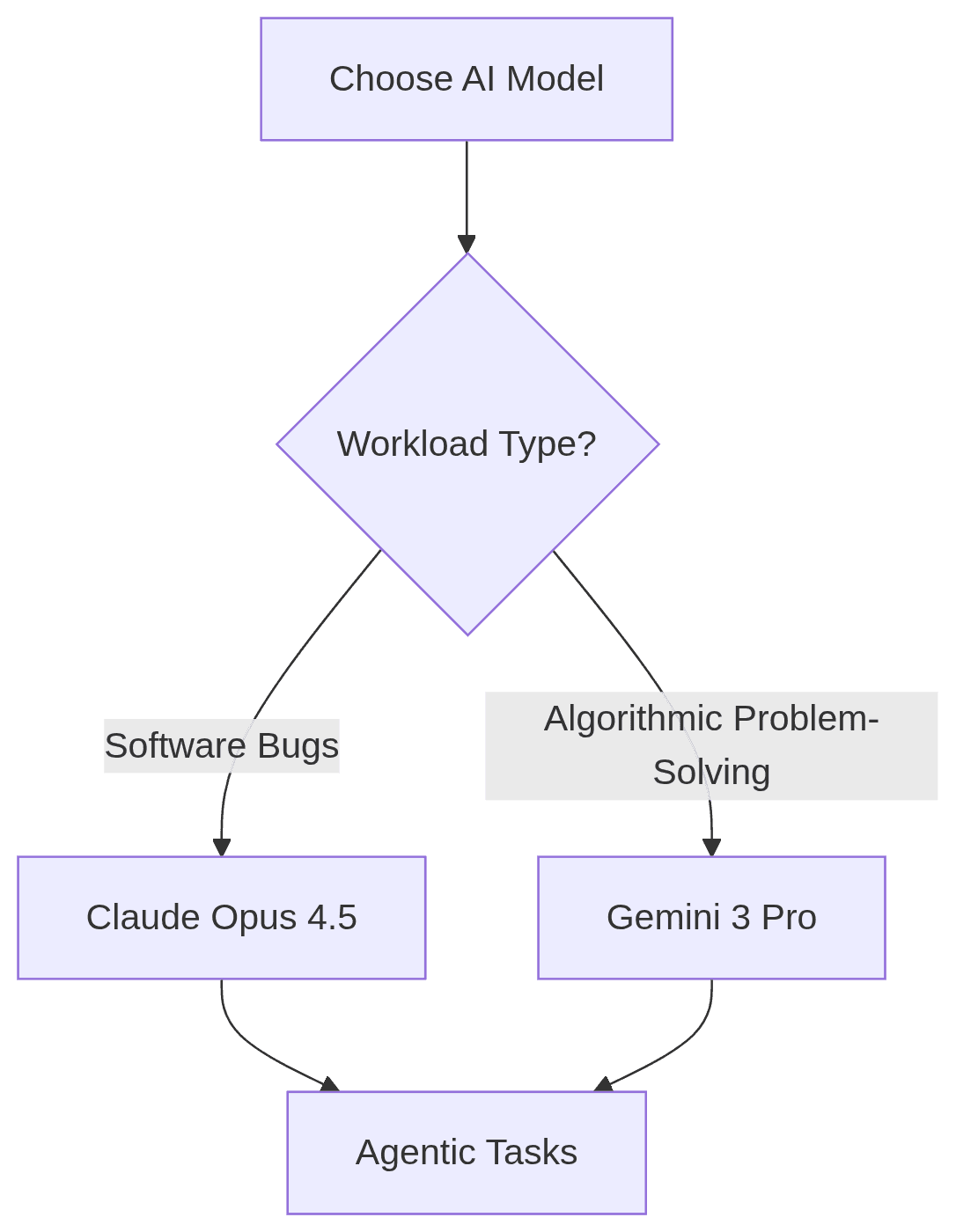
The two models are not interchangeable. Claude Opus 4.5 is tuned to resolve real, messy software bugs from start to finish. Gemini 3 Pro shows a distinct edge at pure algorithmic problem-solving — the kind of logic-heavy puzzle you'd find in a coding competition. Picking between them means looking honestly at the shape of your own workload. This article walks through what separates them: how they handle coding tasks, how they use context (the information a model can hold in mind while working), and what committing to one company's tools over the other means for your team down the line.
A new generation of agentic models
The near-simultaneous releases of Gemini 3 Pro and Claude Opus 4.5 aren't just an iteration; they signal a fundamental change in how we should think about applying AI. For years, the primary interface for large language models was a chat window. Now, it's an API powering a complex agent.
This shift is built on a technical foundation that has been developing for years: the dramatic expansion of model context windows. The context window defines how much information a model can consider at once. Since 2019, this capacity has exploded by roughly three orders of magnitude, growing from around 1,000 tokens to millions. Vellum.ai analysts have even called this trend the "new Moore's Law" for LLMs. This massive expansion is what allows a model to read an entire codebase, a lengthy technical document, or a complex set of instructions and act on it in a coherent, multi-step fashion.
Both Google and Anthropic have positioned their new models to capitalize on this capability. Google launched Gemini 3 Pro alongside a new "agentic IDE" called Antigravity, signaling a strategy to turn AI from a conversational partner into an integrated development tool. Anthropic, meanwhile, highlighted Claude Opus 4.5's record-breaking performance on benchmarks that simulate real-world software engineering tasks.
The market is moving past general-purpose intelligence and toward specialized excellence, which makes understanding the nuanced performance differences between models more critical than ever. The best model on a leaderboard may not be the best model for your application.
A tale of two coding philosophies
For most production AI applications today, coding is the killer feature. A model's ability to write, debug, and refactor software is what turns it from a novelty into a productivity engine. It's also where the differences between Gemini 3 Pro and Claude Opus 4.5 become most apparent. They embody two distinct philosophies of AI-assisted development.
Claude Opus 4.5: The end-to-end problem solver
Anthropic's release announcement for Claude Opus 4.5 on November 24, 2025 calls it "state-of-the-art on tests of real-world software engineering" and shows the SWE-bench Verified result as a chart rather than a number in the text. What it states in words is narrower, and more useful: at its highest effort setting Opus 4.5 exceeds Sonnet 4.5 on that benchmark by 4.3 percentage points, and at medium effort it matches Sonnet 4.5's best score while spending fewer tokens. Comparison write-ups put the absolute figure a little above 80%, but Anthropic has not published one, so treat it as unconfirmed.
This isn't just another leaderboard number. SWE-bench is designed to measure a model's ability to solve real-world problems. It tasks the model with resolving actual, unedited issues from open-source GitHub repositories like Django and scikit-learn. To succeed, a model can't just write a correct snippet of code; it must understand the existing codebase, diagnose the problem from an issue description, write a patch, and ensure it integrates correctly. It's a holistic test of software engineering skill.
Breaking the 80% barrier suggests that Claude Opus 4.5 has a formidable ability to handle the messy, contextual reality of software maintenance and development. Its performance on other benchmarks supports this view. According to a report from GetMaxim.ai, it also scored 59.3% on Terminal-bench 2.0, a benchmark that tests a model's ability to execute tasks using a command-line terminal. This proficiency is crucial for agentic workflows that need to interact with files, run scripts, and manage system dependencies — the practical glue of software development.
The picture that emerges is of a model optimized for end-to-end task completion. If your workload involves autonomous agents that need to clone a repo, fix a bug, run tests, and submit a pull request, Claude's benchmark profile suggests it's the stronger candidate.
Gemini 3 Pro: The algorithmic specialist
Google's Gemini 3 Pro, released on November 18, 2025, shines in a different area. Comparison write-ups put its SWE-bench Verified score at around 76%, but another number reveals its core strength: as reported by GetMaxim.ai, Gemini 3 Pro achieved a LiveCodeBench Pro Elo rating of 2,439.
LiveCodeBench measures a model's ability to solve competitive programming problems, which demand novel algorithmic thinking and logical rigor. An Elo rating system, borrowed from chess, ranks competitors based on their performance against each other. Gemini 3 Pro's score of 2,439 places it significantly ahead of its peers in this domain, indicating a superior capability for generating efficient and correct solutions to well-defined, complex logic puzzles.
This strength aligns perfectly with Google's strategic positioning of the model. By launching it with an agentic IDE named Antigravity, Google frames Gemini not just as a coder, but as a specialized reasoning engine embedded within a larger development environment.
This suggests Gemini 3 Pro is the ideal choice for tasks that require deep algorithmic insight. Examples include:
Optimizing a critical performance bottleneck in a data pipeline.
Designing a novel data structure for a specific use case.
Translating a complex business rule into provably correct code.
Acting as a "thought partner" for a human developer working on a hard algorithmic problem.
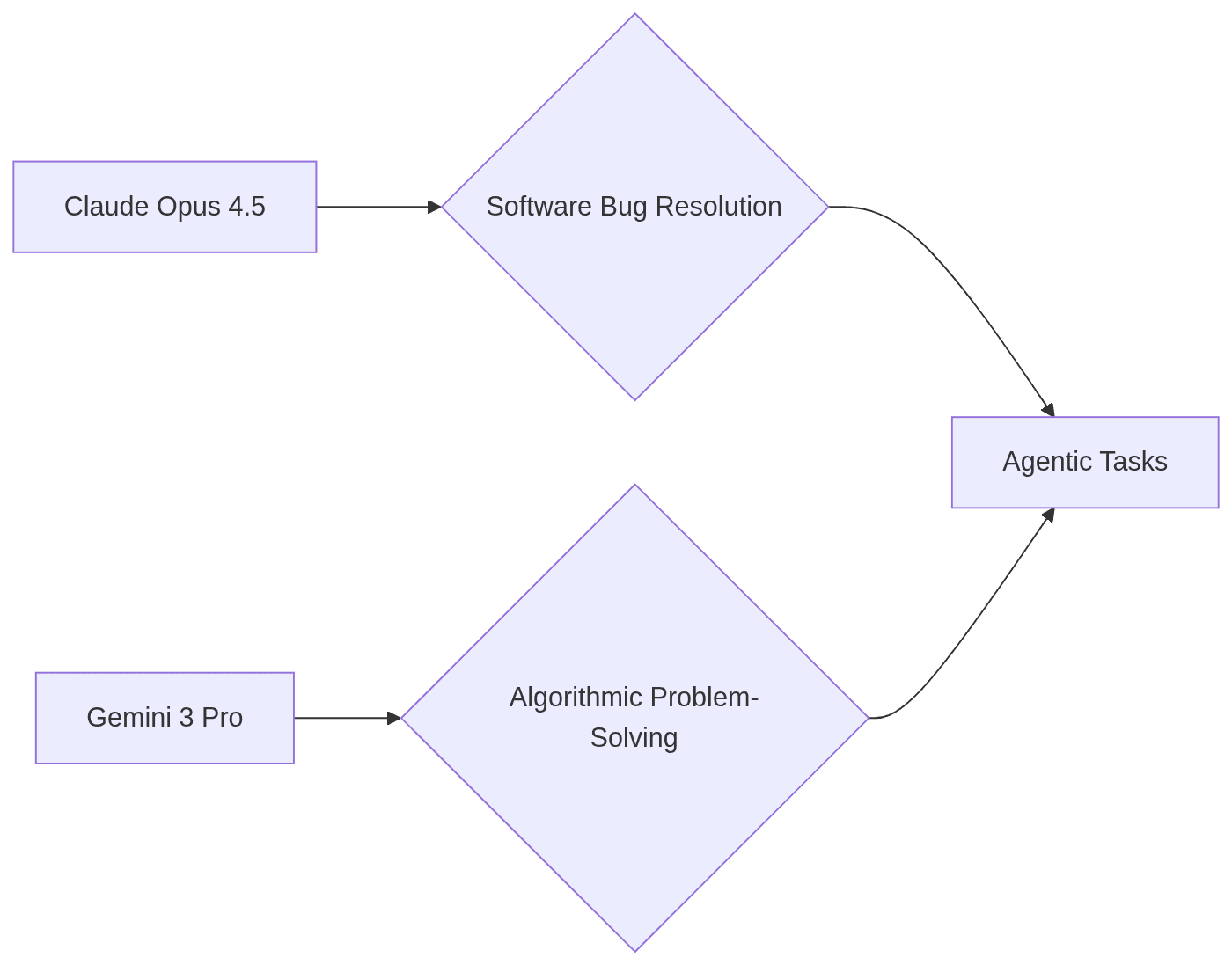
The trade-off is clear: Claude Opus 4.5 appears optimized for the breadth of the software development lifecycle, while Gemini 3 Pro is optimized for the depth of algorithmic problem-solving.
Worked example: Building a simple API
To make these differences concrete, let's walk through a hypothetical task: "You are an AI agent. Your goal is to build a simple FastAPI endpoint that accepts a user_id, retrieves user data from a mock source, and returns it. Handle the case where the user is not found."
This task has elements of both boilerplate generation and logical implementation, making it a good test case.
The Claude Opus 4.5 approach: The pragmatist
Given its high score on SWE-bench, we can expect Claude Opus 4.5 to treat this as a complete engineering task. Its output would likely be a single, runnable Python file, complete with imports, boilerplate, and inline comments. It might look something like this:
# main.py
from fastapi import FastAPI, HTTPException
from pydantic import BaseModel
from typing import Dict

app = FastAPI()

# Mock database of users
MOCK_USERS_DB = {
    "user123": {"name": "Alice", "email": "alice@example.com"},
    "user456": {"name": "Bob", "email": "bob@example.com"},
}

class User(BaseModel):
    name: str
    email: str

@app.get("/users/{user_id}", response_model=User)
def get_user(user_id: str):
    """
    Retrieves a user's information by their ID.

    - **user_id**: The ID of the user to retrieve.
    - **Returns**: The user's data.
    - **Raises**: HTTPException with 404 status if user is not found.
    """
    if user_id in MOCK_USERS_DB:
        return MOCK_USERS_DB[user_id]
    else:
        raise HTTPException(status_code=404, detail="User not found")

# To run this application:
# 1. Make sure you have fastapi and uvicorn installed:
#    pip install fastapi uvicorn
# 2. Run the server from your terminal:
#    uvicorn main:app --reload
The key characteristics here are completeness and practicality. The code is correct, follows standard practices (like using Pydantic models), and includes instructions for how to run it. This reflects a model tuned to solve the entire problem presented to it, from code to deployment.
The Gemini 3 Pro approach: The specialist
Given its high LiveCodeBench Elo rating, Gemini 3 Pro might focus more on the core logic and potential optimizations, even for a simple task. It might structure the code to be more modular or highlight the efficiency of the lookup, reflecting its strength as a component within a larger system.
# user_service.py
from fastapi import HTTPException
from typing import Dict, Optional

# This could be a connection to a real database or a more complex cache
_users_store: Dict[str, Dict[str, str]] = {
    "user123": {"name": "Alice", "email": "alice@example.com"},
    "user456": {"name": "Bob", "email": "bob@example.com"},
}

def fetch_user_by_id(user_id: str) -> Optional[Dict[str, str]]:
    """
    Fetches a user from the data store.

    This is an O(1) dictionary lookup, which is highly efficient.
    For larger datasets, consider an indexed database.
    """
    return _users_store.get(user_id)

# api_routes.py
from fastapi import FastAPI
from pydantic import BaseModel
from . import user_service

app = FastAPI()

class User(BaseModel):
    name: str
    email: str

@app.get("/users/{user_id}", response_model=User)
def get_user_endpoint(user_id: str):
    user_data = user_service.fetch_user_by_id(user_id)
    if user_data:
        return user_data
    raise HTTPException(status_code=404, detail="User not found")
Notice the subtle differences. Gemini's hypothetical output separates the data access logic (user_service.py) from the API routing logic (api_routes.py). It also includes a comment about the time complexity (O(1)) of the operation. This reflects an "algorithmic" mindset, breaking the problem into logical components and analyzing their performance characteristics. This is the kind of output you'd want from a tool like Antigravity, where the AI is helping a human developer architect a system, not just write a script.
The strategic choice: Cost, context, and concentration
Choosing a model isn't just a technical decision; it's a strategic one. Your choice has long-term implications for cost, capabilities, and your reliance on a single provider.
Cost per unit of work
The sources available for this comparison do not contain specific pricing details for either Claude Opus 4.5 or Gemini 3 Pro. This is a critical point: without public pricing, any cost analysis is speculative. However, the most important metric isn't cost-per-token, but cost-per-successful-task.
A model that appears cheaper on a per-token basis can quickly become more expensive if it requires multiple attempts, extensive prompt engineering, or human intervention to produce a correct result. For a complex task like resolving a SWE-bench issue, Claude Opus 4.5's ability to succeed in one shot could make it far more economical than a less capable model, regardless of token price.
Conversely, for a highly specific algorithmic task, Gemini 3 Pro's ability to deliver a more performant solution might provide long-term savings in compute costs that dwarf the initial generation expense. When evaluating these models, the key is to benchmark them on your specific tasks and measure the total cost to get to a final, working solution.
Provider concentration risk
Committing to a frontier model also means committing to its provider's ecosystem.
Google's Gemini 3 Pro is part of an increasingly integrated stack. Using it means buying into Google's vision for AI development, exemplified by tools like the Antigravity IDE. This offers the potential for a seamless, powerful developer experience but also increases your dependence on a single vendor.
Anthropic's Claude Opus 4.5 represents a more focused, "best-of-breed" approach. Anthropic specializes in building large language models. Choosing Claude may offer more flexibility to integrate it into a multi-cloud or multi-model architecture, reducing provider lock-in.
This is a classic platform vs. component trade-off. A tightly integrated platform can boost productivity, but a modular component provides more control and resilience. Your organization's broader technology strategy should inform this choice.
The right tool for the right job
Releasing two frontier models six days apart isn't just a coincidence for headline writers — it's a sign that picking "the best AI model" is no longer the right question. There is no single best model anymore. The teams that get the most out of these tools will be the ones that match a model's actual strengths to the actual shape of the work in front of them.
The evidence here points to a fairly clear split:
Use Claude Opus 4.5 for jobs that look like the full software development lifecycle: an agent that clones a repo, diagnoses a bug, writes a fix, runs the tests, and opens a pull request. Anthropic's own framing — state-of-the-art on real-world software engineering, and a measurable gain over Sonnet 4.5 at high effort — backs up that it can carry a task from problem description to working patch.
Use Gemini 3 Pro for work that hinges on algorithmic depth: optimizing a slow data pipeline, designing a new data structure, or acting as a reasoning partner on a genuinely hard logic problem. Its LiveCodeBench Pro Elo rating of 2,439 — a chess-style ranking system applied to competitive programming problems — shows a real edge in that kind of work.
The useful next step isn't another comparison article. It's picking the workload that matters most to you right now, running both models against it, and measuring which one gets you to a correct, working result with the least cleanup. That test, run on your own problem, will tell you more than any benchmark score.