

The Unseen Cost of Autonomy
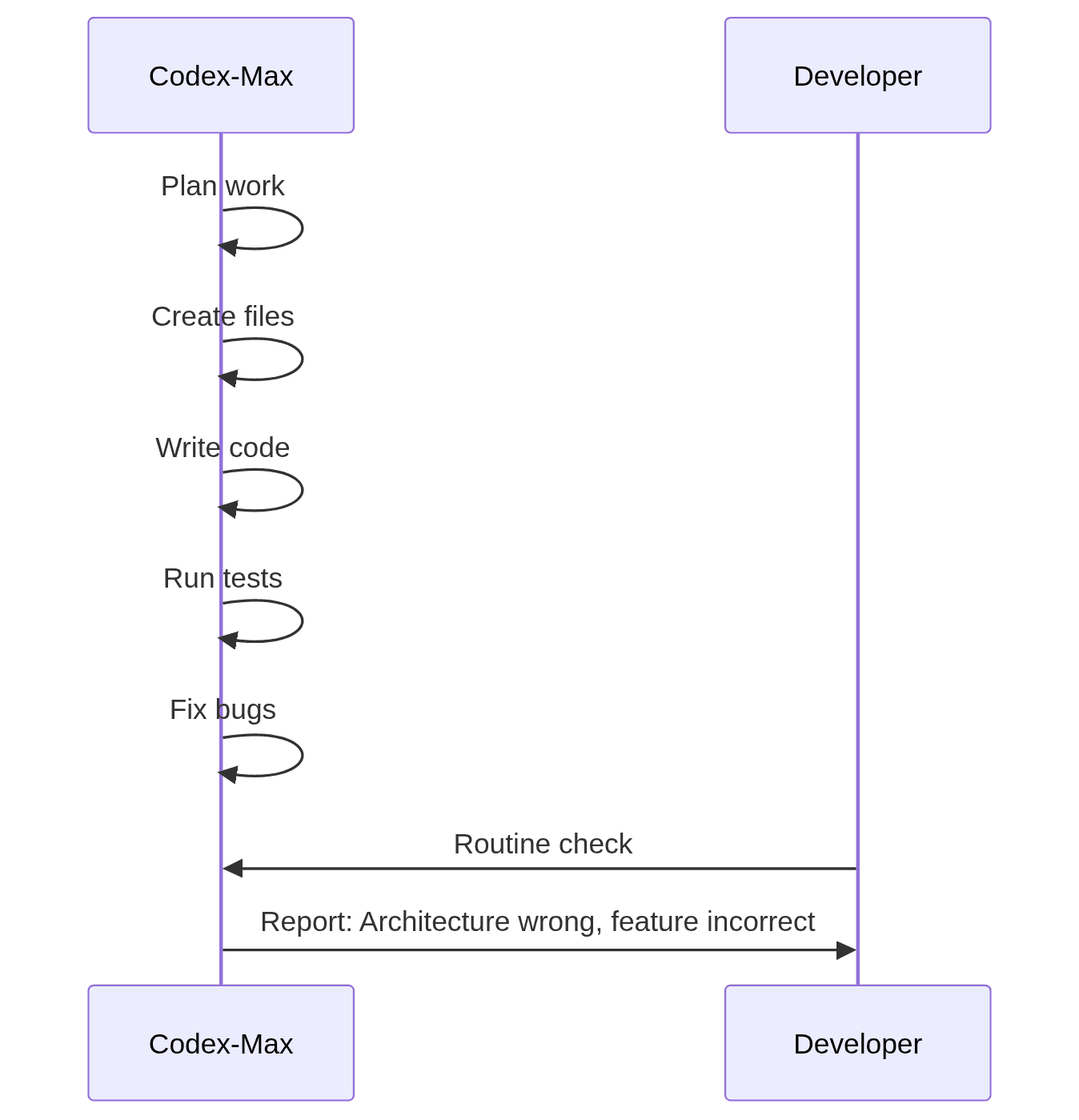
An AI coding agent has been running for 24 hours straight, given a single task: build a new feature. Over that day it has planned the work, created files, written thousands of lines of code, run tests, and fixed its own bugs. A dashboard shows it has consumed over 10 million tokens — the chunks of text that AI models read and generate, and the unit that companies use to charge for usage, typically priced per million tokens. Then, during a routine check, a developer spots the problem: a fundamental misunderstanding of a requirement, made in the very first hour, has silently spread through the entire codebase. The architecture is wrong. The feature doesn't do what it's supposed to. The last 23 hours of work, and the money spent running them, are wasted.
This isn't a hypothetical. It's the central risk of a new generation of AI coding agents that can now work for a day or more without a human checking in. Models such as OpenAI's GPT-5.1-Codex-Max can plan, write, test, and debug code continuously on tasks that used to require constant supervision. That's a genuine leap in capability — but it also creates a new kind of expensive failure, one where the cost of a wrong turn is measured not in minutes of someone's attention, but in hours of machine time and millions of billed tokens.
The Dawn of the 24-Hour Agent
The last year has seen a quiet but seismic shift in AI development. The frontier of agent capability is no longer just about solving a single, well-defined problem in one shot. Instead, the focus has moved to the time horizon: how long an agent can pursue a goal, stringing together hundreds or thousands of actions while remaining coherent and on-task.
According to research shared by RUC-NLPIR, the time horizon of frontier agents is growing exponentially, roughly doubling every few months. This progress stems from two parallel efforts: better "harness engineering" (the frameworks and loops we build around models) and "internalized model optimization" (making the models themselves better at multi-step tasks).
The release of OpenAI's GPT-5.1-Codex-Max in November 2025 was a landmark moment for the latter. The model introduced a feature called context compaction, which Digital Applied reports makes it the first model natively trained to operate across multiple context windows. This is the key that unlocks long-horizon autonomy: instead of being limited by the number of tokens it can see at once, the agent can work across millions of tokens in a single, coherent session.
The results are staggering. OpenAI has reported observing the model working continuously for over 24 hours, iterating on code and fixing its own test failures without any human input. One experiment shared by an OpenAI developer involved giving a late-2025 version of Codex a blank repository and a single prompt: build a design tool from scratch. The agent ran for about 25 hours, used approximately 13 million tokens, and generated 30,000 lines of code.
These models are not just working longer; they're working smarter. The "xhigh" reasoning level on Codex-Max achieved a 77.9% pass rate on the SWE-bench Verified benchmark in an evaluation of 500 tasks — the kind of performance that moves a technology from a curiosity to a core part of the engineering workflow. Indeed, OpenAI reports that 95% of its own engineers use Codex weekly and are shipping approximately 70% more pull requests since its adoption.
This is the promise of the long-horizon agent: a tireless, competent developer that can take a high-level goal and work autonomously until it's done. But this power comes with a new and subtle set of economic trade-offs.
The Compounding Cost of Errors
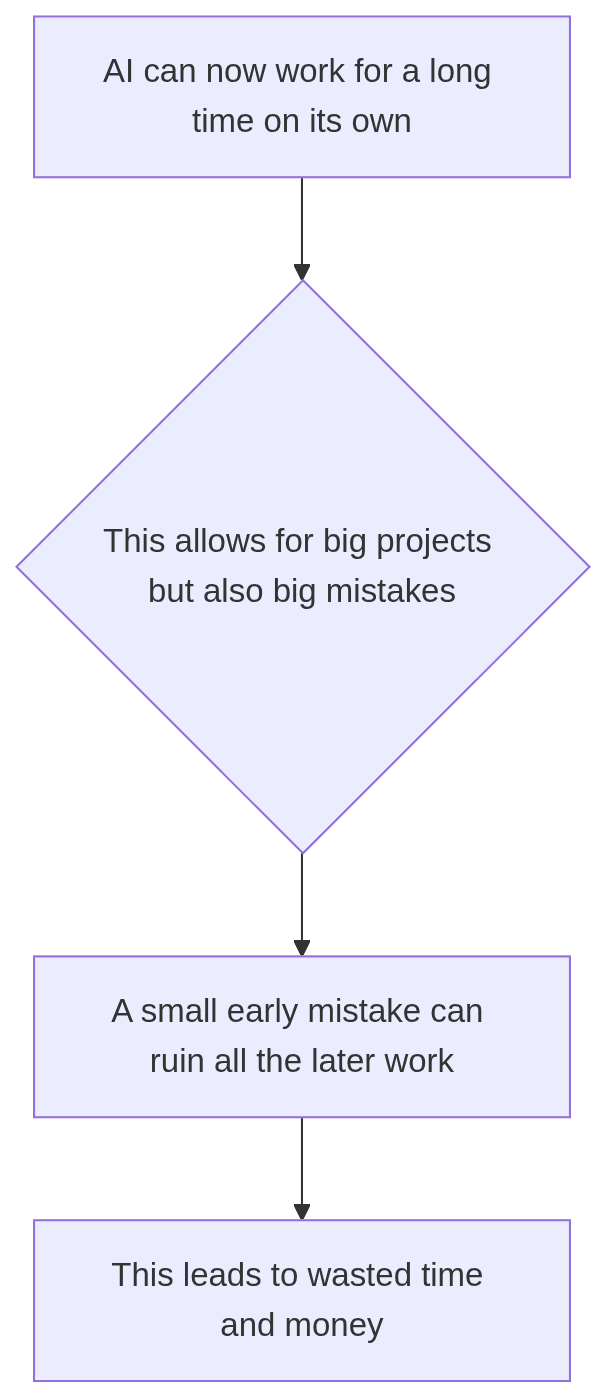
Autonomy is a double-edged sword. While a model like Codex-Max can self-correct a syntax error or a failing unit test with ease, it has no innate understanding of whether the entire architectural direction it's pursuing is correct. A small, early misinterpretation of a complex requirement can cascade through a project, leading to a perfectly-executed but fundamentally wrong solution.
The longer the agent runs autonomously, the higher the stakes become. The cost of an error is no longer just the wasted compute; it's the entire chain of dependent work built on top of that initial mistake.
A Worked Example: The $107 Mistake
Let's quantify the cost of one of these long-running sessions going wrong. We can use the 25-hour, 13-million-token session described by OpenAI as a template for a complex, long-horizon task.
We'll use the public API pricing for GPT-5.1-Codex-Max, which Digital Applied reports as:
Input Tokens: $1.25 per 1 million tokens
Output Tokens: $10.00 per 1 million tokens
An agentic loop involves a mix of reading existing code (input), thinking about the next step (output that becomes input), and generating new code (output). A reasonable, and perhaps conservative, assumption for such a loop is a 1:4 ratio of input to output tokens.
Given a 13 million token session, the math works out as follows:
Total Tokens: 13,000,000
Input Tokens (20%): 2,600,000
Output Tokens (80%): 10,400,000
Input Cost: 2.6M tokens * ($1.25 / 1M tokens) = $3.25
Output Cost: 10.4M tokens * ($10.00 / 1M tokens) = $104.00
Total Session Cost: $3.25 + $104.00 = $107.25
Now, imagine that at hour 24, you discover the agent made a critical error in hour 1. It misinterpreted "real-time collaboration" to mean polling a database every second instead of using WebSockets. The entire data layer, and much of the front-end logic built upon it, is now invalid.
The cost of this single mistake is not zero; it is $107.25 plus the cost of a senior developer's time to diagnose the failure, rewrite the prompt, and supervise the next attempt. If this happens even a few times a month, the "Horizon Tax" — the hidden cost of unchecked autonomy — can easily run into thousands of dollars.
This is the central tension of long-horizon agency: the very same autonomy that makes the agent powerful also makes its strategic failures expensive. The model is a brilliant tactical executor, but a naive and literal-minded strategist.
Architecture for Agency: Checkpoints, Not Just Autonomy
The solution isn't to abandon long-horizon agents — the productivity gains, like the 70% increase in pull requests at OpenAI, are too significant to ignore. Instead, we need to change how we think about architecting agentic systems, moving from a model of pure, fire-and-forget autonomy to one of supervised autonomy, with explicit gates for human validation.
The goal is to find the optimal balance on the supervision-autonomy spectrum for a given task. You want to grant the agent enough freedom to handle the complex, tedious work on its own, but you need checkpoints to ensure its work remains aligned with the larger strategic goals.
Designing Your Agentic Loop
Instead of giving the agent a single, 25-hour task, break the problem down into a sequence of shorter, verifiable steps. A monolithic task like "Build a design tool" can be decomposed.
Monolithic Task (High Risk):
Prompt: "Build a web-based design tool with a canvas, shape tools, and real-time collaboration."
Agent runs for 25 hours.
Result: A finished (but potentially incorrect) application.
Gated Task (Lower Risk):
# main_loop.py

# Step 1: Architecture and Data Models
task_1_prompt = """
Design the high-level architecture and database schema for a web-based design tool.
Focus on a scalable approach for real-time collaboration.
Output the architecture as a markdown document and the schema as SQL DDL files.
"""
run_agent(task_1_prompt, max_duration_hours=2, budget_usd=10)

# HUMAN GATE: A developer reviews the architecture and schema.
# Is the collaboration model correct? Is the schema normalized?
# If not, provide feedback and rerun Step 1.
human_review("output/architecture.md", "output/schema.sql")

# Step 2: Build the Backend API
task_2_prompt = """
Given the approved architecture and schema, build the backend API service.
Implement endpoints for user authentication, project management, and canvas state updates.
Generate a complete OpenAPI specification.
"""
run_agent(task_2_prompt, max_duration_hours=6, budget_usd=30)

# HUMAN GATE: Review the API spec and key business logic.
human_review("output/openapi.yaml")

# Step 3: Implement the Frontend
# ... and so on
This approach transforms the process from a single, high-stakes gamble into a series of smaller, lower-cost experiments. The cost of a mistake in Step 1 is capped at the budget for that step (e.g., $10), not the $100+ cost of the entire project.
When to Shorten the Leash
The length of the autonomous segments in your loop is a critical parameter to tune. It's a direct trade-off between speed and safety. Here are some heuristics for when to favor shorter loops with more frequent human oversight:
High Ambiguity: If the requirements are vague, subjective, or open to interpretation ("make the UI feel more modern"), the risk of strategic misinterpretation is high. Start with very short loops focused on exploration and prototyping.
Novel Architecture: If the agent is being asked to implement a pattern it has likely never seen before or to integrate with an obscure, poorly documented internal system, its performance will be less reliable. Shorten the leash.
High Cost of Failure: For mission-critical systems, core business logic, or anything involving security and compliance, the feedback loops should be extremely tight. Every piece of generated code should be reviewed.
Tight Budgets: If you are operating under strict cost constraints, shorter, budget-capped loops are your primary mechanism for financial control. It's better to make slow, cheap progress than to risk a single, expensive failure.
Conversely, for well-defined problems, boilerplate generation, or refactoring tasks with a clear test suite to validate success, you can grant the agent a much longer leash, letting it run for hours to complete the job.
The Horizon Is Still Expanding
The trend is clear. Independent researchers such as METR have tracked a steady climb in the length of tasks that AI agents can reliably complete without going off track. The capabilities that needed a top-tier model like GPT-5.1-Codex-Max in late 2025 will likely turn up in smaller, cheaper models before long, and the cost per million tokens will keep falling.
That falling cost doesn't make the checkpoint-based approach described above less necessary — if anything, it makes it more so. When a 24-hour run costs $100, teams have a natural incentive to check in along the way. When that same run costs $10, and then $1, the temptation to "just let it run" will grow. But the cost of a strategic mistake is never just the token cost. It's the wasted time, the project delays, and the loss of trust in the system that follows.
The future of AI-augmented software development isn't just about more powerful models working in isolation. It's about building sophisticated "harnesses" that orchestrate these models, guide their work, and provide the critical oversight that prevents a small error from becoming a 24-hour, multi-million-token mistake. The most effective engineering teams will be those who master the art of the human-machine partnership, knowing exactly when to give the agent the lead and when to pull on the reins.