

Your Six-Figure Problem Might Be Simpler Than You Think
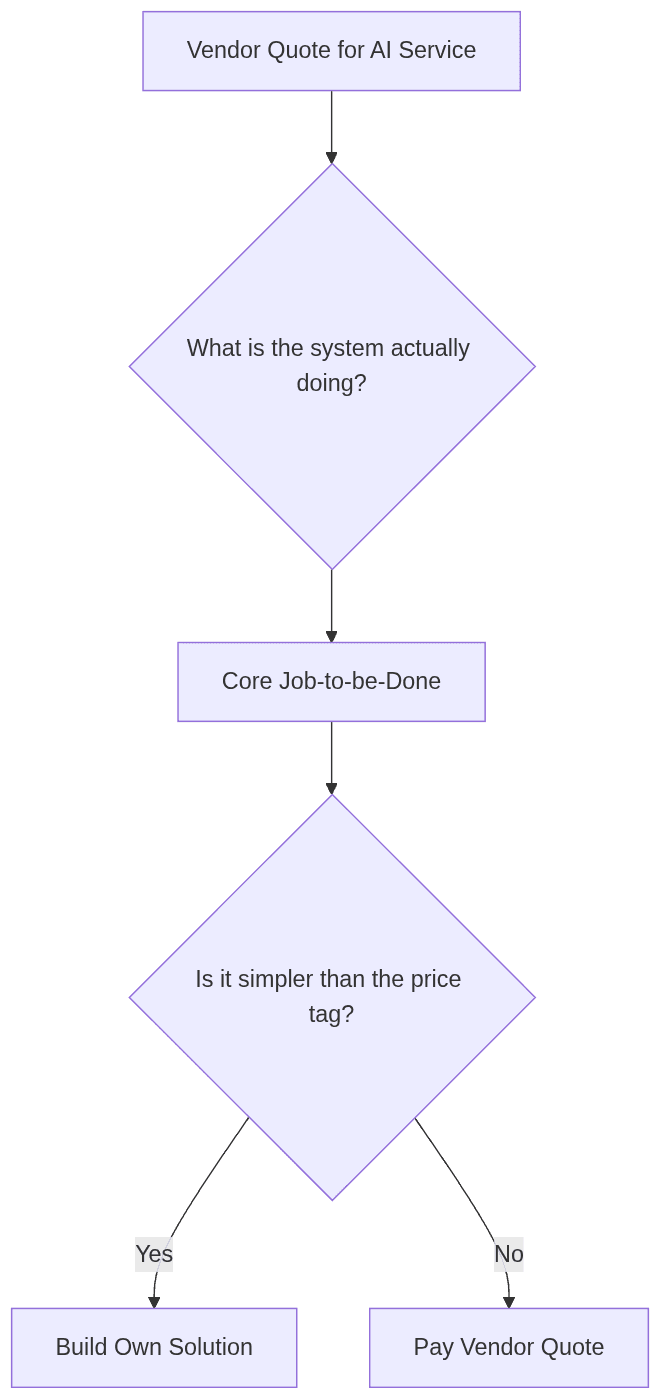
An engineer got a quote for $120,000 to replace the scoring system in his family's bowling alley. When he dug into what the system actually did, he found it was using a computer mainly to flip a single switch — triggering a 70-year-old mechanical pinsetter. He built a replacement himself using off-the-shelf parts for about $200 per lane, roughly $1,600 in total. That's the idea behind what this article calls the "Bowling Alley Test": before you pay a vendor a fortune for a system wrapped in marketing language, figure out what the system is actually doing underneath. It might be a lot simpler than the price tag suggests.
The same trap catches companies buying AI services. A vendor's website is slick, the whitepaper is full of impressive benchmark scores, and the demo runs flawlessly. They promise a system that can summarize documents, classify user feedback, or write code with superhuman skill. Then comes the price tag — steep, but seemingly justified by the promised value. Before signing, it's worth asking a simple question: what are you actually paying for? As the bowling alley story shows, the honest answer is often much simpler — and cheaper — than the vendor lets on.
This article walks through that story, shows how the same lesson applies to AI vendors, and explains how to build your own small, targeted test to make sure you're buying what you actually need.
The Six-Figure Relay
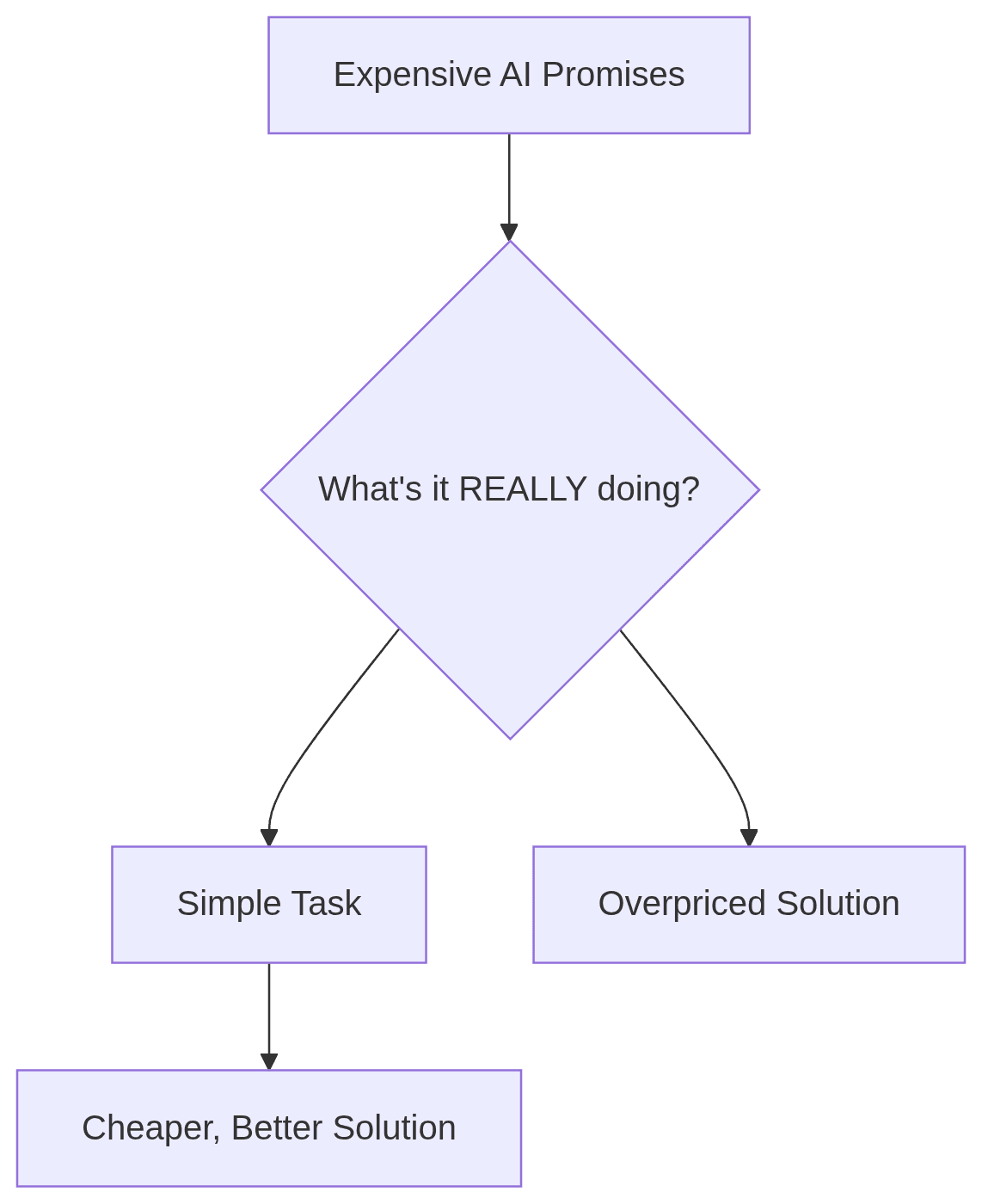
An SRE who bought an abandoned 8-lane bowling center in the rural Midwest found himself facing a situation familiar to anyone running a business: an outrageous vendor quote. The facility itself cost him $105,000. Replacing the scoring system, which was installed in 2008, would cost between $80,000 and $120,000. Replacement parts for the existing system were a staggering $4,000 per pair of lanes.
This system was sophisticated for its time, handling camera-based pin detection, ball speed calculation, animations, and control of the pinsetter. But as the engineer dug in, a crucial fact emerged: the bowling machines themselves were 70-year-old mechanical wonders, and the expensive, modern scoring system's primary interaction with them was, in his words, "actuating a single relay to trigger that big old machine."
The vendor was selling a feature-rich, integrated solution. But the core job-to-be-done was flipping a switch. The six-figure price tag, the opaque internal workings, and the exorbitant cost of parts were all built around this simple action.
This realization prompted a different approach. As he wrote on Hacker News, "Given the state of open hardware, computer vision, real-time event streaming, and open source running megascale products worldwide, there had to be a way to do this myself."
He built a prototype replacement for about $200 per lane. Using common off-the-shelf components like ESP32 microcontrollers and a Raspberry Pi, he replicated the necessary functionality for a fraction of the vendor's price. The total cost for his DIY system was around $1,600, compared to the $120,000 quote for a like-for-like replacement from a vendor. He wasn't just saving money — he was trading a costly, opaque black box for an open, affordable system he understood, could repair, and could improve.
Your AI Might Be a Bowling Pinsetter
The bowling alley story is more than an anecdote; it's a perfect model for the risks of adopting third-party AI systems. Vendors sell you "intelligent document processing," but you might just need reliable text extraction. They offer "AI-powered customer sentiment analysis," but you might just need to count keywords in support tickets. The gap between the marketed capability and the core task can be enormous, and that gap is where your budget disappears.
Opaque Costs and Misaligned Value
The bowling scoring system's cost was disconnected from its primary function. The same is often true for AI APIs. You are presented with a simple pricing model — per token, per call, per million characters — but this abstracts away the true cost and complexity. Is the model you're using oversized for your task? Are you paying premium prices for a state-of-the-art model to perform a task a much smaller, cheaper model could handle?
Like the $120,000 system actuating a single relay, you might be using a massive, general-purpose AI to effectively "flip a switch" in your own workflow. The vendor has no incentive to tell you this. Their goal is to sell you access to their most powerful, and often most expensive, systems. Without a clear understanding of the minimum viable intelligence required for your task, you are at the mercy of their pricing and product tiers.
The Black Box and the Standards Vacuum
The old scoring system was a black box. When it broke, the owner was dependent on the original vendor for shockingly expensive parts and service. AI platforms are the ultimate black boxes. You have no visibility into their architecture, training data, or failure modes beyond what the vendor chooses to share.
This creates significant integration risk. A key question to ask any potential API provider, as one developer noted in a Hacker News discussion, is: "How do they handle deprecation?" When the vendor releases a new version of their model or API, what happens to your application? Will your prompts still work? Will the output format remain consistent? Will performance change?
In the world of web development, standards bodies like the W3C provide a crucial layer of stability. Specifications for HTML, CSS, and WebRTC ensure that the platform evolves in a somewhat predictable way. As a 2019 W3C report highlights, this ecosystem is the result of decades of work to create interoperability. But the report also shows that at that time, "Web & Machine Learning" was only just beginning to be explored as a potential area for standardization.
Years later, the field remains a wild west. You are not buying into a stable, standardized platform; you are betting on a single company's proprietary technology. If their priorities change, your application breaks.
Building Your 10-Example Sanity Check
You cannot trust a vendor's benchmark table to reflect your reality. The data used for these benchmarks is often cleaner than your own, and the tasks may not align with your specific needs. The only way to know if a model will work for you is to test it on your data.
This doesn't mean you need to run a massive, academic-style evaluation. You can gain enormous clarity with a small, private "sanity check" benchmark of just ten examples. The goal is not to publish a paper; it's to answer one question: "Can this service reliably do the job I need it to do?"
Step 1: Define Your Core Tasks
Forget the marketing hype. What are the 3-5 most critical, specific tasks you expect this AI to perform? Be precise.
Bad: "Summarize documents."
Good: "Extract the counterparty name, effective date, and liability cap from our standard sales contracts."
Bad: "Improve customer support."
Good: "Classify incoming support tickets into one of five categories: 'Billing', 'Technical Issue', 'Feature Request', 'Account Access', or 'Other'."
Step 2: Gather Your Real-World Data
Find two or three real examples for each core task you defined. Do not use clean, sanitized examples from the internet. Use your own data, with all its typos, formatting quirks, and ambiguity.
For contract analysis, use PDFs of actual, signed agreements.
For support ticket classification, copy and paste the raw text from your ticketing system.
For generating marketing copy, use your internal product descriptions and spec sheets.
Your 10 examples should be representative of the messy reality the AI will face in production.
Step 3: Define Success and Failure
For each of your ten examples, write down what a correct output looks like. This is your evaluation rubric. Be just as specific as you were when defining your tasks.
For classification: The output must be exactly one of the predefined categories.
For extraction: The output must be a JSON object containing the correct values for
counterpartyName,effectiveDate, andliabilityCap. Any other format is a failure. Any incorrect value is a failure.For generation: The output must mention the key product feature and adhere to the company's style guide for tone of voice.
Step 4: Write the Test Script
Your test isn't a data science experiment; it's an integration test. The process of automating API calls can be as simple as writing a small script. The goal is to simulate the exact commands your application would send. A tutorial on controlling Android devices with Python provides a useful mental model for this: the script performs a series of concrete actions like input tap x y or input text "hello world!" and expects a specific outcome. Your benchmark script should be no different.
Here is a conceptual Python example. It doesn't use a real AI library, but it illustrates the structure of a single test case for our ticket classification task.
# This is a conceptual example.
# Replace with your vendor's actual API client.

def run_classification_test(api_client, ticket_text, expected_category):
    """
    Sends a single ticket to the vendor's API and checks the result.
    """
    print(f"--- Testing Ticket ---")
    print(f"Input: '{ticket_text[:70]}...'")
    print(f"Expected: {expected_category}")

    try:
        # This is the actual call to the vendor's service.
        # The structure of this call will depend on their SDK.
        result = api_client.classify({
            "document_text": ticket_text,
            "categories": ["Billing", "Technical Issue", "Feature Request", "Account Access", "Other"]
        })

        # Your validation logic goes here.
        # It must be strict.
        actual_category = result.get("classification")

        print(f"Actual: {actual_category}")

        if actual_category == expected_category:
            print("✅ PASS")
            return True
        else:
            print(f"❌ FAIL: Category mismatch.")
            return False

    except Exception as e:
        print(f"❌ FAIL: API call failed with error: {e}")
        return False

# --- Your Test Data ---
test_case_1 = {
    "text": "Hi, I can't seem to log into my account. I tried resetting my password but the email never arrived.",
    "category": "Account Access"
}

# --- Running the test ---
# client = initialize_vendor_api_client("YOUR_API_KEY")
# run_classification_test(client, test_case_1["text"], test_case_1["category"])
Run your ten examples through this process. Don't just look at the accuracy score. Read every single failure. Is the model consistently failing on a specific type of input? Is the output format unreliable? These are the integration problems that a benchmark table will never show you, and they are the issues that will sink your project in production.
Don't Buy the Black Box
The market for AI services is young, expensive, and missing the shared standards that make other parts of the software world predictable. Vendors will keep showing you polished demos and benchmark tables, but their incentives point toward selling you the most powerful — and priciest — tier of their product, not the cheapest one that would actually do your job.
Before you sign a six-figure contract, apply the Bowling Alley Test. Ask what the system is actually doing underneath the marketing: is it extracting three fields from a form, or sorting a ticket into one of five buckets? Ask the vendor directly how they handle deprecation — what breaks in your application when they retire a model version. And build the ten-example benchmark described above, using your own messy data, before you trust anyone else's numbers. Sometimes the answer will be that the vendor's tool is worth every dollar. But sometimes, like the bowling alley owner who swapped a $120,000 black box for $1,600 in parts he understood and could fix himself, you'll find the simpler, cheaper, and more transparent option was there all along.