

Your LLM is a brilliant idiot
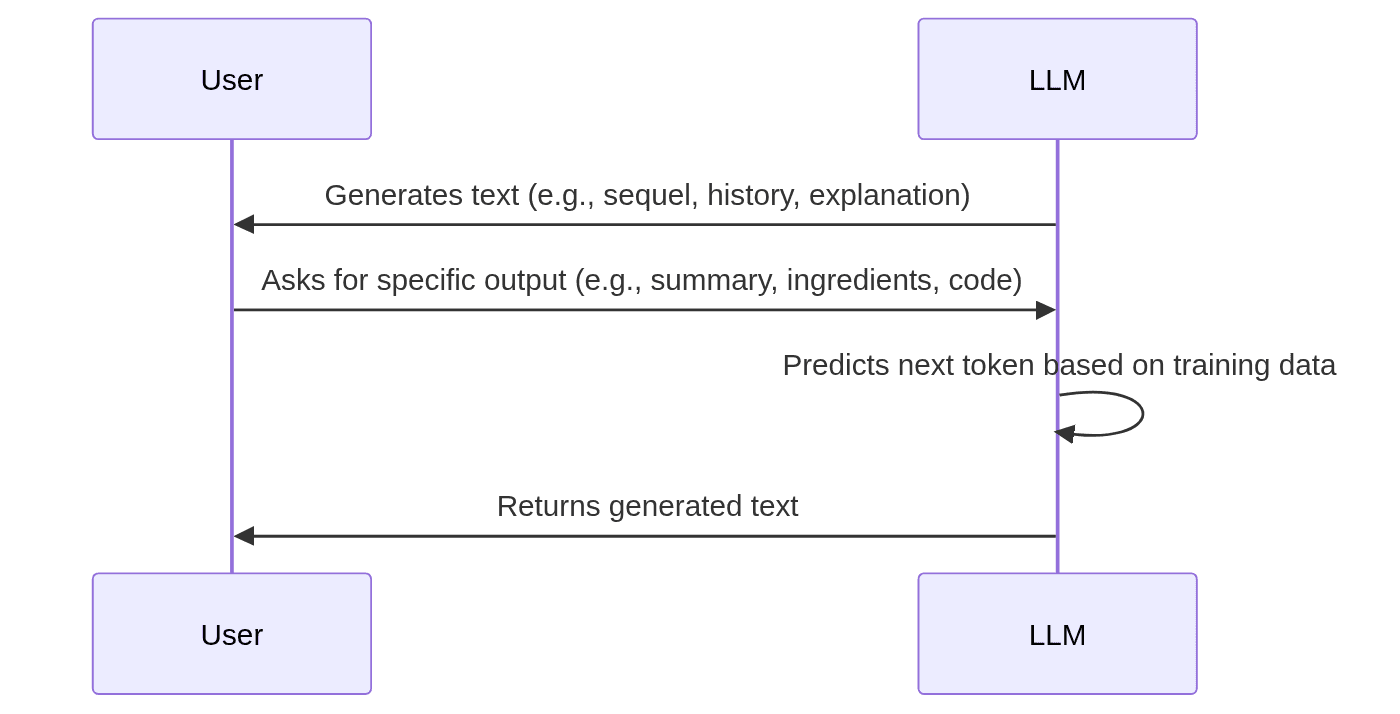
You ask a large language model (an LLM — a type of AI trained to generate text) for a concise summary of a news article, and it starts writing a sequel. You ask it to list the ingredients from a recipe, and it gives you a history of the dish. You ask it to write a function in Python, and it writes a perfect explanation of what the function would do, but no actual code.
The model is generating fluent, relevant, and often impressive text. It just isn't doing what you asked.
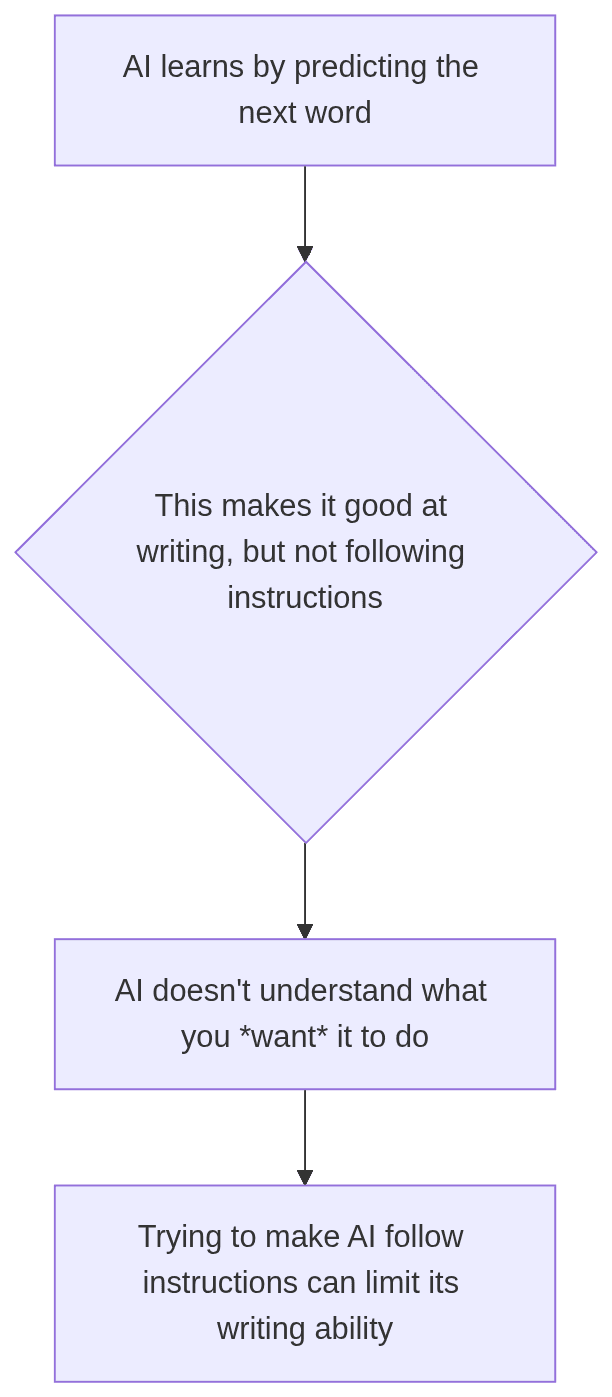
This frustrating gap between what you wanted and what the model actually does isn't a bug; it's a direct consequence of how these models are built. At their core, LLMs are "next-token predictors": vast neural networks trained to do one simple job — given a stretch of text, guess the single most probable next word, or "token" (a token is just a chunk of text, sometimes a whole word, sometimes a piece of one). This training, done on terabytes of text scraped from the internet, makes them extraordinary mimics of human writing patterns. But it doesn't teach them to be helpful assistants. A model trained this way has no built-in concept of an "instruction" or a "user." It only knows which words tend to follow which other words. And across a web full of forum posts, articles, and code snippets, the statistically likely continuation of your prompt is not always the helpful one.
The Prediction Engine and the Intent Gap
To understand why base language models fail at instructions, we need to look under the hood at their training objective. Imagine the model has processed the phrase "The first person to walk on the moon was." Its task is to calculate a probability distribution over its entire vocabulary — tens of thousands of tokens — for the very next piece of text.
In a well-trained model, the token for "Neil" will have a very high probability. "Buzz" might have a lower but still significant probability. "a" will have a low probability, and "bicycle" will have a probability near zero. The model samples from this distribution to pick the next token, appends it to the sequence, and repeats the process. This is all it does: it is a machine for completing text.
This objective is powerful. It's what allows models to write poetry, draft emails, and generate code. But notice what's missing: there is no objective function for "truthfulness," "helpfulness," or "following the user's command." The model follows instructions correctly only when the correct answer happens to be the most statistically likely continuation of the prompt, based on its training data.
Consider this prompt:
User: Please summarize the following text for me.
Text: [a long article about cellular biology]
Summary:
A base model might generate a brilliant, one-paragraph summary. Or, it might generate a second paragraph of the article, because articles in its training data often have more than one paragraph. It might even generate a list of "Related Articles," because that's a common pattern at the end of online content. All of these are plausible text completions. Only one is useful.
This fundamental mismatch between the training objective (plausible text generation) and the user's goal (task completion) is the central problem that alignment research seeks to solve. How do you take a powerful prediction engine and turn it into a reliable tool?
Defining What "Good" Looks Like
Before you can optimize a model to follow instructions, you need a clear definition of what a "good" response is. This is more complex than it sounds. Over the years, researchers in this field have converged on a few key principles. A well-aligned model's response should be:
Helpful: It should attempt to perform the user's explicit or implicit task. If the user asks for a summary, it should summarize. If the user asks for code, it should provide code. It should not dodge the question, provide a meta-commentary on the question, or do something else entirely.
Honest: The model should not knowingly fabricate information. This is distinct from simply being wrong. If a model doesn't know the answer, it should say so rather than generating a plausible-sounding but false statement. This is a huge challenge for systems trained to produce "plausible" text at all costs.
Harmless: The model must refuse to generate dangerous, unethical, abusive, or illegal content. This is a non-negotiable safety rail.
These three principles — helpfulness, honesty, and harmlessness — form the foundation of model alignment. They are the target. The next problem is figuring out how to aim the model at that target.
The Failure of Automated Metrics
The first instinct of any machine learning practitioner is to define a quantitative metric and optimize for it. For text, we have metrics like BLEU and ROUGE, which measure the overlap of words and word sequences between a generated text and a reference text.
These work well for tasks like translation, where there's a limited set of high-quality translations for any given sentence. They fail completely for open-ended instruction following.
Imagine you ask a model: "Explain the concept of gravity to a five-year-old."
Here are three possible good answers:
"Imagine the Earth is a giant magnet, and you have a little piece of metal in your shoe. The Earth is always pulling you down so you don't float away!"
"Everything that has stuff in it pulls on everything else! The Earth is really, really big, so its pull is super strong. That's what keeps you on the ground."
"Gravity is an invisible force that pulls things toward each other. The Earth is huge, so it pulls you and everything around you toward it. It's what makes a ball fall when you drop it."
None of these share much vocabulary. A BLEU or ROUGE score comparing response #2 to reference #1 would be terrible. An automated metric can't capture the quality of an explanation, the creativity of an analogy, or the nuance of tailoring a response to a specific audience.
To measure performance on these tasks, you need a different kind of judge: a human. The most effective way to evaluate these models is to have people rate the responses. Is response A better than response B? This simple, scalable comparison is a far richer signal of quality than any automated metric. And this insight — that human preference is the ground truth for quality — is the key to training models that are actually helpful.
The Alignment Tax
So, you have a set of principles (helpful, honest, harmless) and a way to measure them (human preference). The next step is to incorporate this into the model's training, to steer its behavior toward these goals. This process, broadly known as "alignment," is crucial for creating safe and useful AI. But it comes with a cost.
This cost is often referred to as the alignment tax: a reduction in a model's raw capabilities on certain benchmarks as a direct result of making it safer and more helpful.
It's a classic engineering trade-off. When you optimize a system for multiple objectives, you often can't achieve the maximum on all of them simultaneously. Pushing the model to be more harmless might make it overly cautious, refusing to answer legitimate but sensitive questions about medicine or finance. Pushing it to be more "honest" (i.e., less likely to invent information) might make it less creative in storytelling tasks.
Where the Tax is Paid
The alignment tax manifests in several ways:
Reduced Performance on Capability Benchmarks: An unaligned base model, focused solely on next-token prediction, might score exceptionally high on benchmarks that measure its knowledge or reasoning abilities in a zero-shot setting (i.e., without specific examples). After alignment, which trains the model to follow conversational patterns and refuse certain prompts, its performance on those same academic benchmarks can drop. The model has learned to be more conversational and cautious, which can interfere with the direct, pattern-matching reasoning that excels at multiple-choice questions.
Over-Refusal: A key goal of alignment is to prevent the model from generating harmful content. However, defining "harmful" is difficult. An overzealous safety model might cause the LLM to refuse perfectly reasonable requests. For example, a user asking for code to perform a security scan on their own network might be refused because the model classifies it as "hacking." This is a false positive, where the model's safety training is too broad and reduces its utility.
Loss of "Personality" or Creativity: Sometimes, the process of aligning a model to be a neutral, helpful assistant can sand down its more interesting edges. The model might become more repetitive, use more caveats and disclaimers, and adopt a bland, corporate persona. This is often a side effect of training on human preferences, which can favor safe, inoffensive, but less creative responses.
The existence of the alignment tax doesn't mean we shouldn't align models. It means that the process is not one of simple improvement, but of managing complex trade-offs. The goal is not just to build the most powerful model, but to build the most beneficial one. This requires carefully balancing capability with safety, performance with reliability.
The Path Forward is Human-Centered
Turning a raw next-token predictor into a helpful assistant means changing what we're asking the model to do — from "generate plausible text" to "understand and carry out my intent." That shift doesn't happen on its own, and it doesn't happen just by making models bigger or feeding them more data. It takes a deliberate, human-centered process: deciding what we value, building ways to measure it, and training that into the model through feedback loops like the ones described above.
None of this is solved yet. We still need clearer ways to define what "good" behavior looks like for tasks that don't have a single right answer, cheaper and faster ways to collect human judgments at scale, and a better handle on exactly where the alignment tax bites hardest — so that fixing one weakness (say, refusing harmful requests) doesn't quietly break something else (say, answering a legitimate medical question, or writing a genuinely creative sentence).
For now, the trade-off is real and worth keeping in mind. A model that's slightly less sharp on a benchmark but far more likely to tell you "I don't know" instead of making something up, or to hand you working code instead of a well-written description of code, is usually the more useful tool. So the next time an LLM hedges, adds a caveat you didn't ask for, or politely declines a request that seems perfectly reasonable, you're not looking at a broken system. You're looking at the alignment tax being paid — the ongoing, imperfect price of turning a brilliant idiot into something you can actually rely on.
References
Ouyang et al. (2022), Training Language Models to Follow Instructions with Human Feedback ↗
Askell et al. (2021), A General Language Assistant as a Laboratory for Alignment ↗
Stiennon et al. (2020), Learning to Summarize from Human Feedback ↗
Papineni et al. (2002), BLEU: a Method for Automatic Evaluation of Machine Translation ↗
Lin (2004), ROUGE: A Package for Automatic Evaluation of Summaries ↗