

A change with no diff
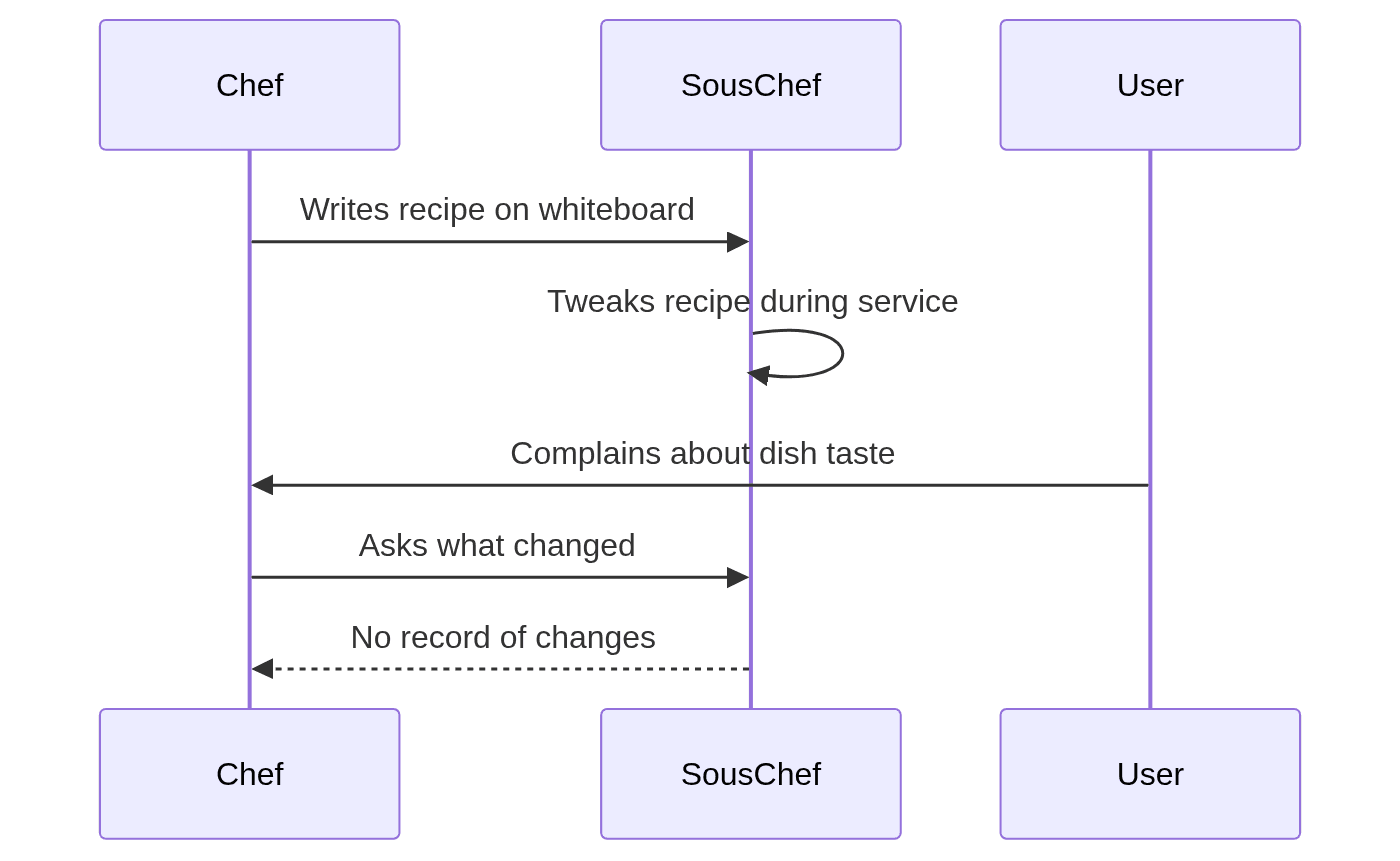
Imagine a restaurant where the head chef scribbles the recipe for the signature dish on a whiteboard in the kitchen. Every sous chef is free to tweak it during service—a pinch more salt here, a little less thyme there. When a customer complains the dish tastes different, nobody knows exactly what changed, who changed it, or how to make the original version again.
This is how most teams manage their AI prompts. A "prompt" is just the set of instructions you give to an AI model—the recipe for how it should behave. Changing that recipe is a real production change, with real consequences for what users see. Yet at most companies, it happens with no record, no review, and no way to undo it if something goes wrong.
Prompt versioning fixes this by treating every prompt like a proper piece of software instead of a note on a whiteboard. Each version of a prompt gets a unique ID, is tested before it's used for real, and can be instantly swapped back to an older version if it causes problems—like keeping a dated, labeled copy of every recipe draft instead of erasing and rewriting the same card. This gives you a single source of truth, so you can always answer the question: "Which exact recipe produced this result?" It turns messy, ad-hoc experimentation into an organized engineering process, making your AI features more reliable and your team far more productive.
How it works
The core problem with prompt management is that most teams start by hardcoding prompts as strings directly in their application code. This is simple for a prototype, but it's a recipe for disaster in production. A 2025 industry survey by Maxim AI found that engineering teams spend 30-40% of their AI development time on prompt engineering, and for companies with more than 10 prompts, versioning is a top-three operational challenge. The chaos of untracked changes is a primary reason for this inefficiency.
Treating prompts as deployable artifacts solves this. The approach rests on two foundational principles:
Prompts are stored and managed outside your application code in a centralized registry.
Prompts are immutable. Any change creates a new version; old versions are never modified.
This creates a clear, auditable history and decouples the prompt lifecycle from the code deployment lifecycle.
What is a "Versioned Prompt"?
A versioned prompt is far more than just the text of the prompt itself. A common mistake is to version only the instructional string, when the model's output actually depends on the entire execution context. A reliable version must capture every parameter that influences generation.
A complete prompt version artifact includes:
Prompt Identifier: A unique name for the prompt (e.g.,
customer_support_triage_agent).Version Tag: An immutable version, ideally using semantic versioning (e.g.,
v1.2.1). This helps communicate the impact of a change at a glance.Prompt Template: The text of the prompt, including any variables (e.g.,
{{user_query}}).Model Parameters:
model_name: The specific model the prompt was tuned for (e.g.,claude-3-opus-20240229). A prompt written for one model may not work well with another.temperature: The sampling temperature. A prompt designed for greedy decoding (temperature: 0.0) is a different instrument than one written for creative generation (temperature: 0.7).top_p: The nucleus sampling parameter.max_tokens: The maximum number of tokens to generate.stop_sequences: A list of strings that should cause the model to stop generating.
Metadata:
author: Who created this version.timestamp: When it was created.changelog: A human-readable description of what changed and why.eval_results: A link to or summary of evaluation metrics for this version.
Here's what a versioned prompt might look like in a YAML configuration:
prompt_id: "support_ticket_summarizer"
version: "v2.1.0"
metadata:
  author: "jane.doe@example.com"
  timestamp: "2025-11-10T14:30:00Z"
  changelog: "Minor improvement. Added instruction to extract ticket ID. Increased max_tokens to handle longer inputs."

# Execution context
model: "gpt-4-turbo"
parameters:
  temperature: 0.2
  max_tokens: 512
  stop_sequences:
    - "\n---"

# The prompt template itself
template: |
  You are an expert support agent. Summarize the following support ticket into a single paragraph.
  The summary must be concise and include the user's primary issue and the requested action.
  Always extract the ticket ID if it is present.

  Format the output as follows:
  **Summary:** [Your summary here]
  **Ticket ID:** [ID or N/A]

  ---
  Ticket content:
  {{ticket_body}}
  ---
This entire object—not just the template—is the versioned artifact.
The Deployment Workflow: From Dev to Production
Once prompts are externalized, you can manage their deployment across different environments, just like any other software component. This workflow prevents production breakage and enables safe, rapid iteration.
The process involves three key components: a prompt registry, environment pointers, and evaluation gates.
Centralized Prompt Registry: This is the single source of truth for all prompts. It's a database or service where every immutable prompt version is stored. Teams can browse history, compare versions, and see which versions are active in which environments.
Staged Deployment via Environments: Instead of hardcoding a prompt, your application code fetches it from the registry by referencing an environment tag.
The
devenvironment might point to a highly experimental version.The
stagingenvironment points to a release candidate that is undergoing final testing.The
productionenvironment points to the stable, user-facing version.
Your application code looks something like this, fetching the prompt dynamically:
# An example of fetching a prompt from a management service
import os
from prompt_registry_client import get_prompt

# The environment is set via an environment variable, not in code
APP_ENVIRONMENT = os.environ.get("APP_ENV", "dev")

# Fetch the active prompt for this environment
try:
    summarizer_prompt = get_prompt(
        prompt_id="support_ticket_summarizer",
        environment=APP_ENVIRONMENT
    )
    # Now use summarizer_prompt.template, summarizer_prompt.model, etc.
    # to make the LLM call.
except PromptNotFound:
    # Fallback or error handling
    log.error("Could not fetch prompt from registry.")
Promotion and Rollback: Promoting a prompt from
stagingtoproductionis not a code deploy. It is a simple pointer change in the registry, re-tagging which version is considered "production." This operation should be instant.The trade-off here is introducing a new piece of infrastructure (the registry) and a network call to fetch the prompt. However, the benefits in safety and speed far outweigh the latency of a single API call, which can be heavily cached.
Crucially, this same mechanism enables instant rollbacks. If
v2.1.0is causing issues in production, rolling back tov2.0.0is as simple as updating theproductiontag to point to the older version. The change takes seconds, requires no code redeploy, and immediately mitigates the issue.
Versioning for Chains and Agents
The need for versioning becomes even more acute in complex systems with multi-prompt dependencies, such as agentic workflows or chains. A change to an upstream prompt (e.g., a "router" prompt that decides which tool to use) can cause cascading failures across all downstream steps.
Without versioning, debugging these systems is nearly impossible. With versioning, you can trace a failure back through the entire execution graph. When you log the output of an LLM call, you must also log the full version identifier of the prompt that produced it (e.g., support_ticket_summarizer:v2.1.0). This turns debugging into a simple query, not a treasure hunt.
For these complex systems, it's best practice to version the entire chain or agent configuration as a single artifact, pinning the versions of all constituent prompts. This ensures that the entire interdependent system is promoted and rolled back as one coherent unit.
What this means in practice
Adopting a disciplined prompt versioning workflow has immediate, tangible consequences for cost, speed, and reliability. It turns prompt engineering from a high-risk art into a managed engineering discipline.
For developers, it reduces firefights and rework. The 30-40% of development time spent on prompt engineering isn't all creative work—much of it is debugging, manually re-testing changes, and chasing down regressions that crept in unnoticed. By linking every output back to a specific prompt version, debugging becomes trivial: instead of asking "what's even running in production right now?", you can just check the logs. And by requiring automated evaluations before a new version can be promoted, you catch problems before they reach users, cutting down on panicked rollbacks and late-night hotfixes.
For product managers and domain experts, it enables safe collaboration. Prompts are where a product's personality, tone, and business logic actually live, so non-engineers often have valuable input on them. A proper versioning system gives them a safe sandbox to experiment in—they can try changes, compare outputs side by side, and submit a new version for review, all without touching the application's code. This widens the circle of people who can contribute, without loosening engineering standards.
For the business, it means shipping faster with higher quality. The biggest bottleneck in AI feature development is usually how long it takes to test an idea and see the result. When changing a prompt means a full code deployment, that cycle takes hours or days, which discourages teams from making small, careful improvements. Once prompt releases are separated from code releases, that cycle shrinks to minutes. And because rollback is instant and low-risk, teams feel safer experimenting and shipping more often. Speed plus safety, together, is a real competitive edge.
The cost of the old way isn't just wasted engineering hours—it's the features you never got around to shipping. A team that can safely test and deploy five prompt variations in a day will systematically outperform a team that can only manage one deploy per week.
Where this is heading
Prompt versioning is rapidly becoming standard practice, but the discipline is still evolving. Three trends are likely to shape where it goes next.
First, what counts as a "versioned artifact" will keep growing. Today, best practice is to version the prompt text and the model settings. Soon, that will expand to cover the full context a prompt runs in—retrieval configurations (the rules for what background documents or data get pulled in), tool and function definitions the AI can call, and even the datasets used to evaluate quality. Instead of versioning individual prompts, teams will version entire "reasoning pipelines"—the whole chain of steps an AI system follows—as one single, indivisible unit. This is my own reading of the trajectory, but it seems like the logical next step as these systems grow more complex.
Second, versioning and evaluation will become more tightly and automatically linked. There's already a clear trend toward merging these two functions. I expect that soon, proposing a new prompt version will automatically trigger a batch of quality tests, with the results—accuracy scores, cost-per-call estimates, response-time benchmarks—posted straight back to the review conversation. Promoting a prompt to production will simply be blocked if it doesn't clear a minimum quality bar. This would make improving AI behavior as rigorous and checked-off as standard software release processes are today.
Finally, the tools themselves will get more sophisticated. Simple registries will grow into full-fledged "Prompt IDEs"—dedicated workspaces for prompt work, the way code editors are dedicated workspaces for programming. These will offer not just version tracking, but collaborative editing, side-by-side comparisons of outputs from different versions, and built-in tools for testing multiple variants against real users. That would let teams manage a prompt's entire life, from first draft to production monitoring, in one place. Early versions of such platforms already exist, and it's my opinion that they'll become as essential to AI developers as code editors are to software engineers today.
The days of editing prompts as a loose string of text buried in code are ending. The teams that build the most reliable, advanced AI applications will be the ones who treat their prompts with the same engineering discipline they'd give any other critical piece of software.