
Your Review Queue is a Graveyard. Here's Why.
Your team built an AI system to automate a tedious task, like categorizing customer support tickets. It's 95% accurate, a huge technical success. To catch the last 5%, you built a human review queue — a list of items the model is unsure about, waiting for a person to check them. A month later, nobody is using it. The queue is a ghost town of stale requests, and bad predictions are slipping through to production. The project, despite its high-performing model, is a failure.
This story is common. The problem isn't the model; it's the design of the human-machine collaboration. The field calls this "human-in-the-loop," or HITL: a system where a person checks or corrects an AI's output before it's finalized. But in practice, we often design it so the human is a reluctant, rubber-stamping afterthought — someone clicking "approve" on things they haven't really evaluated. If reviewing the AI's work is more tedious, slower, or less rewarding than doing the original task manually, your team will abandon it.
A successful HITL system isn't about verifying an AI's correct answers. It's a partnership where human expertise is applied surgically, at the point where it will change the outcome the most. This article details four principles for designing HITL systems that your team will actually use:
Make review faster than the original task.
Focus human attention on genuine uncertainty.
Integrate the review into the user's native workflow.
Treat the review queue as the invaluable evaluation set it already is.
The Anatomy of a Failed Review Queue
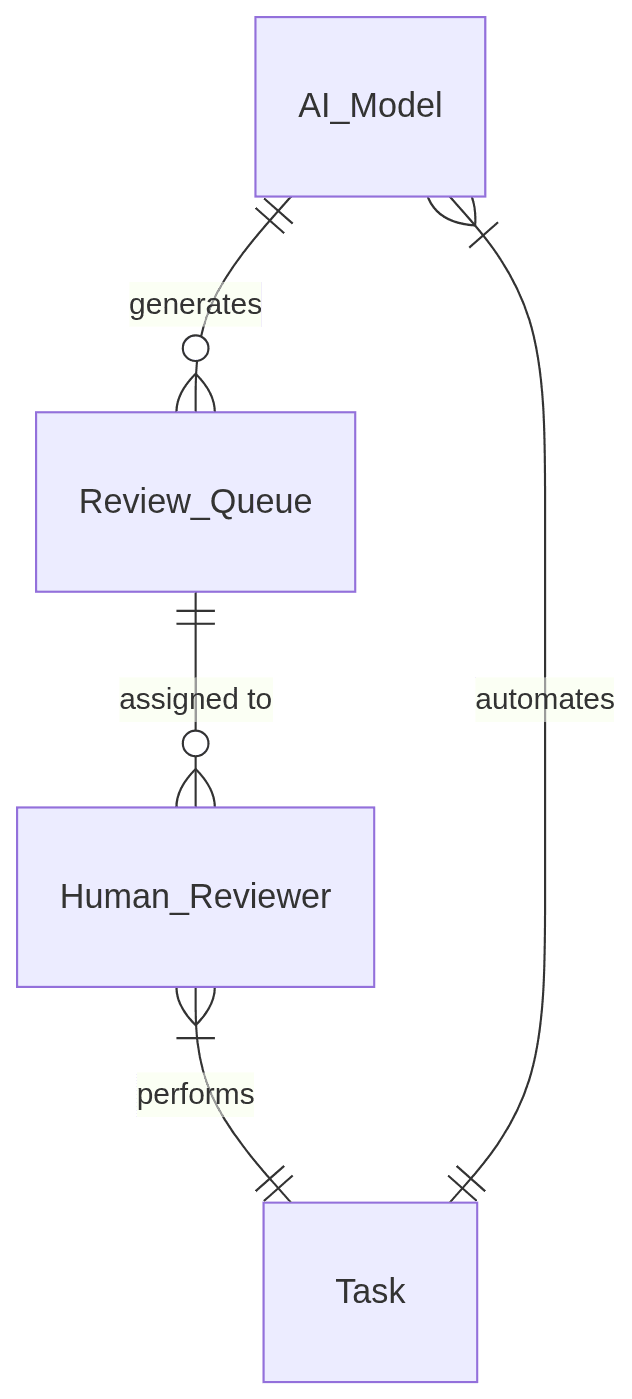
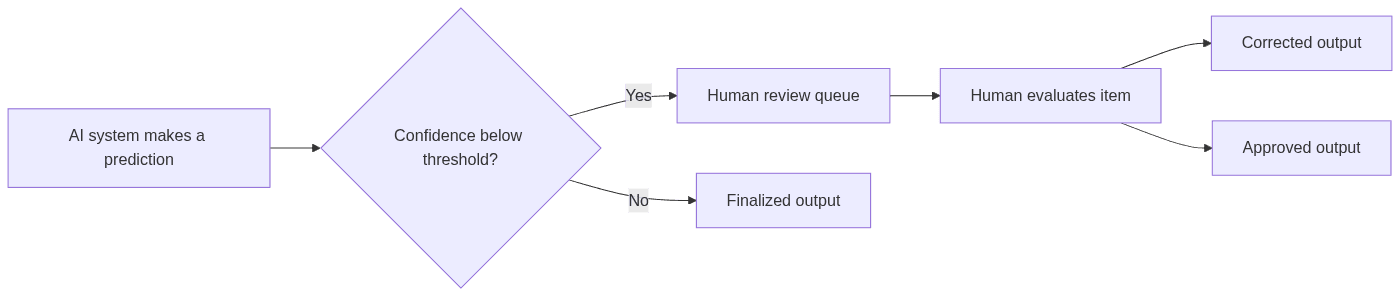
Before we build a better system, we need to understand why the default approach fails. The typical HITL process looks like this: the model makes a prediction, and if its confidence is below a certain threshold, it goes into a queue. A human then opens a separate dashboard, looks at the item, and clicks "Approve" or "Reject."
This design is doomed for several reasons:
It's a chore. The work is boring. For a 95% accurate model, even the "low confidence" items are mostly correct. The human spends their day clicking "Approve" on an endless list, a task with all the cognitive engagement of a CAPTCHA.
It's too slow. The context switch is expensive. The user has to stop their real work, open a different tool, load the queue, understand the context of the item, make a decision, and then return to their original task. It's often faster to just do the task manually in the first place.
It provides no value to the reviewer. The queue feels like a one-way street. The human provides corrections, but they rarely see the model improve as a direct result. Their effort disappears into a void, and the same mistakes reappear next week.
It asks the wrong question. "Approve/Reject" is a binary choice that misses the point. Often, a prediction isn't completely wrong, just slightly off. A rejected item has to be redone from scratch, while an approved-but-imperfect item degrades data quality. The interface lacks the tools to make a quick, small correction.
A system that is slow, boring, and unrewarding will be abandoned. The fix is to invert each of these failures: a good HITL system is fast, engaging, provides a clear feedback loop, and empowers the user to make nuanced, high-impact contributions.
Principle 1: Make Review Faster Than Creation
This is the golden rule. The total time a user spends interacting with the AI — reviewing, correcting, and finalizing — must be less than the time it would take them to do the task from scratch. Fail that test, and the system fails with it.
This isn't about making the user click a button faster. It's about designing the entire interaction to be an accelerator, not a brake. Instead of a post-mortem review of a finished product, the interaction should be a collaboration.
Consider the world of generative AI. Projects like FireRed-OpenStoryline, an AI video editing agent, reframe the process from manual editing to "intention-driven directing." The user doesn't wait for the AI to produce a full video and then approve it. Instead, they use natural language to guide the process, asking the agent to find clips, generate a script, and recommend music. The human is a director, not a quality assurance checker. The "review" happens continuously, as part of the creative flow.
The same principle applies to text. The langchain-ai/social-media-agent is designed to source content and draft social media posts. A failing implementation would ask a social media manager to "approve" a list of 20 machine-written tweets. A successful implementation, as the project intends, presents a generated draft in an interface where the user can quickly make edits before publishing. Writing a post from scratch might take 15 minutes. Editing a solid AI-generated draft takes two. That's a win.
How to Implement It
Provide an editable draft, not a final product. Whether it's a social media post, a code block, or a document summary, show the user the AI's output in a text box, not as a static label. Let them fix a typo or rephrase a sentence directly.
Build the UI for correction. The interface should make common corrections easy. If your AI classifies documents, don't just offer "Approve/Reject." Offer a dropdown of the top 5 most likely alternative labels. The user's action should be a single click to correct, not a rejection followed by a manual re-entry.
Co-locate the source and the suggestion. If the AI is summarizing a document, show the summary alongside the original document with the relevant passages highlighted. Don't make the reviewer hunt for the source material to verify the AI's work.
Principle 2: From Rubber Stamp to Surgical Strike
A human's time is your most valuable resource. Don't waste it reviewing things the model already knows. The goal of HITL is not to achieve 100% review coverage; it's to apply human intelligence to the model's specific points of confusion. This requires two things: surfacing uncertainty and sampling intelligently.
Instead of asking "Is this right?", the system should ask, "I'm confused about this specific part. Can you help?"
This changes the user's role from a simple verifier to a high-value consultant. DALL·E Flow, a workflow for generating images from text, provides a powerful example. It doesn't just generate one image. It uses multiple models to generate several candidates, then uses CLIP to rank them against the prompt, and presents a selection to the user. The user's job is not to say "yes" or "no" to a single image; it's to select the most promising candidate from a set of diverse options. This intervention point is incredibly high-leverage: the user's choice resolves the ambiguity in the original text prompt and guides the rest of the generation process, including diffusion and upscaling.
How to Implement It
Go beyond confidence scores. A low confidence score tells you the model is uncertain, but it doesn't tell you why. Use model-specific techniques to find the source of the uncertainty. For a language model, this might be a sentence with high-entropy token predictions. For a classifier, it might be an input that sits near a decision boundary between two specific classes.
Present choices, not just problems. When the model is uncertain, have it generate several distinct hypotheses and present them to the user. "Is this a 'billing' or 'technical support' ticket? I'm 55% sure it's 'billing', but here's why it might be 'technical support'."
Embrace strategic sampling. You don't need to review everything, even below a confidence threshold. Start by sampling a small, random percentage of all predictions to establish a baseline accuracy. Then focus the rest of your review budget on the areas of highest uncertainty or highest business impact. If a misclassification costs the company $10,000, it should have a higher priority for review than one that costs nothing.
Principle 3: Integrate, Don't Segregate
If your review queue lives in a separate dashboard that users have to remember to log into, it's already failed. The friction of the context switch will kill adoption. The review process must live where your users work.
The langchain-ai/social-media-agent provides a clear example of this principle by integrating with Slack. When a post is ready for review, the agent doesn't just add it to a web queue — it sends a message to a specific Slack channel, where the user can review, edit, and approve the post without leaving the application they already have open all day.
This is a profound shift in design. You are bringing the work to the user, not forcing the user to go find the work.
Multi-agent systems are also adopting this philosophy. AgentTeams, for instance, is an open-source framework that uses Matrix, a decentralized chat protocol, as its backbone for coordinating agents. This means a team of agents working on a task appears as a group of participants in a chat room. A human can simply join that room to monitor progress, answer questions, and correct the course of the work. The "review" is just a conversation in a chat client, and the entire history of the interaction becomes a readable, searchable log — perfect for both oversight and later analysis.
How to Implement It
Identify the user's "workbench." Is it Slack? Microsoft Teams? A specific CRM? A GitHub repository? Build your HITL integrations there.
Use actionable notifications. A notification should not just say "You have 10 items to review." It should present the first item directly in the notification, with buttons for the most common actions (e.g., "Approve," "Edit in Thread").
Treat the review as a conversation. The user should be able to "reply" to the AI. This is the model behind
AgentTeamsandFireRed-OpenStoryline. The human input is part of an ongoing dialogue, not a form submission.
Principle 4: Your Review Queue is Your Best Evaluation Set
The final, and perhaps most crucial, principle is to close the loop. Every human interaction — every correction, every choice, every edit — is a high-quality data point. It's a signal telling you exactly where your model is failing, and wasting it is a cardinal sin of MLOps.
Your review queue is your evaluation set. It's a continuously updated, targeted collection of your model's most challenging and important failure modes.
When a user in the social-media-agent workflow edits a generated post, that action creates a valuable data pair: (original AI-generated text, human-edited text). Storing this in a database like Supabase, as suggested in the agent's documentation, is the first step. The next step is to use these pairs. They can be:
Added to an evaluation set: To track model performance on tricky cases over time.
Used as few-shot examples: To improve prompt performance for a specific user's style. The
langchain-ai/social-media-agentexplicitly mentions customizing post style, a process that could be automated with this data.Compiled into a fine-tuning dataset: To periodically retrain the model and teach it to avoid the mistakes that humans are repeatedly correcting.
This feedback loop is what transforms a static HITL system into a dynamic, self-improving one. It also provides immense value back to the user: the work they do today makes their job easier tomorrow, because the AI gets smarter — a powerful motivator for continued engagement. Agent frameworks like ARS-Codex, which package complex workflows into skills with specific hooks and scripts, are well suited for this. A "review" hook can be designed to log these interactions automatically, feeding them back into the agent's knowledge base or a fine-tuning pipeline.
The Trade-Offs: What You Give Up for a System That Lasts
Building a usable HITL system is not free. It requires shifting effort from pure model development to product and system design. You are trading short-term implementation speed for long-term sustainability and data quality — and you should go in knowing exactly what that trade costs.
Development cost. Building a slick, integrated review flow — an editable message inside Slack, say, rather than a bare API endpoint dumping rows into an HTML table — takes real developer time. You're paying for the user's experience of the review process, not just the review logic itself.
Feedback richness vs. speed. A form that asks the reviewer to categorize the error, explain their reasoning, and suggest an alternative gives you rich, structured data to learn from. It also takes longer to fill out, and people will start skipping it. A plain edit-in-place text box gets used, but the signal it produces — a changed sentence, a swapped label — is messier to analyze. You have to pick a point on that trade-off deliberately, not by accident.
System complexity. A queue that samples intelligently, surfaces the reason for uncertainty, and logs every correction for retraining has more moving parts than a simple confidence-threshold queue: more logging infrastructure, more decisions about what counts as "uncertain enough," and an actual plan for what happens to the data afterward.
Human fatigue. Even a well-designed system wears people down if it asks for too much. This is why intelligent sampling and genuine-uncertainty targeting aren't optional extras — they're what keeps the queue from becoming the graveyard described at the start of this article. Every time you route a case to a human that the model could already handle correctly, you spend down their patience and their trust that the exercise is worthwhile.
The real choice isn't between a simple system and a complex one. It's between a system people keep using six months from now and one that quietly empties out, while the model's mistakes keep shipping to production unreviewed. The graveyard of forgotten review queues exists because teams treated the human's experience as a secondary concern. For HITL to work, it has to be the main design problem, not an afterthought bolted onto a finished model.