

The Unseen Skill Behind Every Good AI Answer
You ask an AI to summarize an article, and it returns a paragraph that misses the point entirely. You ask it to write code, and it hands you a script full of bugs. You ask for marketing ideas, and you get a list of clichés you could have written yourself. In each case, the model appears to understand your words but not what you actually wanted. The problem usually isn't the AI — it's the gap between what you meant and what you actually typed.
Closing that gap is a skill called prompt engineering: the practice of designing the input you give an AI model so it produces the specific, useful output you're after. A prompt isn't just a question typed into a box — it's a set of instructions, context, and constraints: a plan for guiding the model toward one particular answer instead of the thousands of other plausible answers it could give. Learning this skill is what separates people who treat a language model like a magic eight ball, shaking it and hoping for a lucky answer, from people who use it as a precise, reliable tool. It's the difference between a response that merely sounds plausible and one that is actually correct, properly formatted, and genuinely useful for the job at hand.
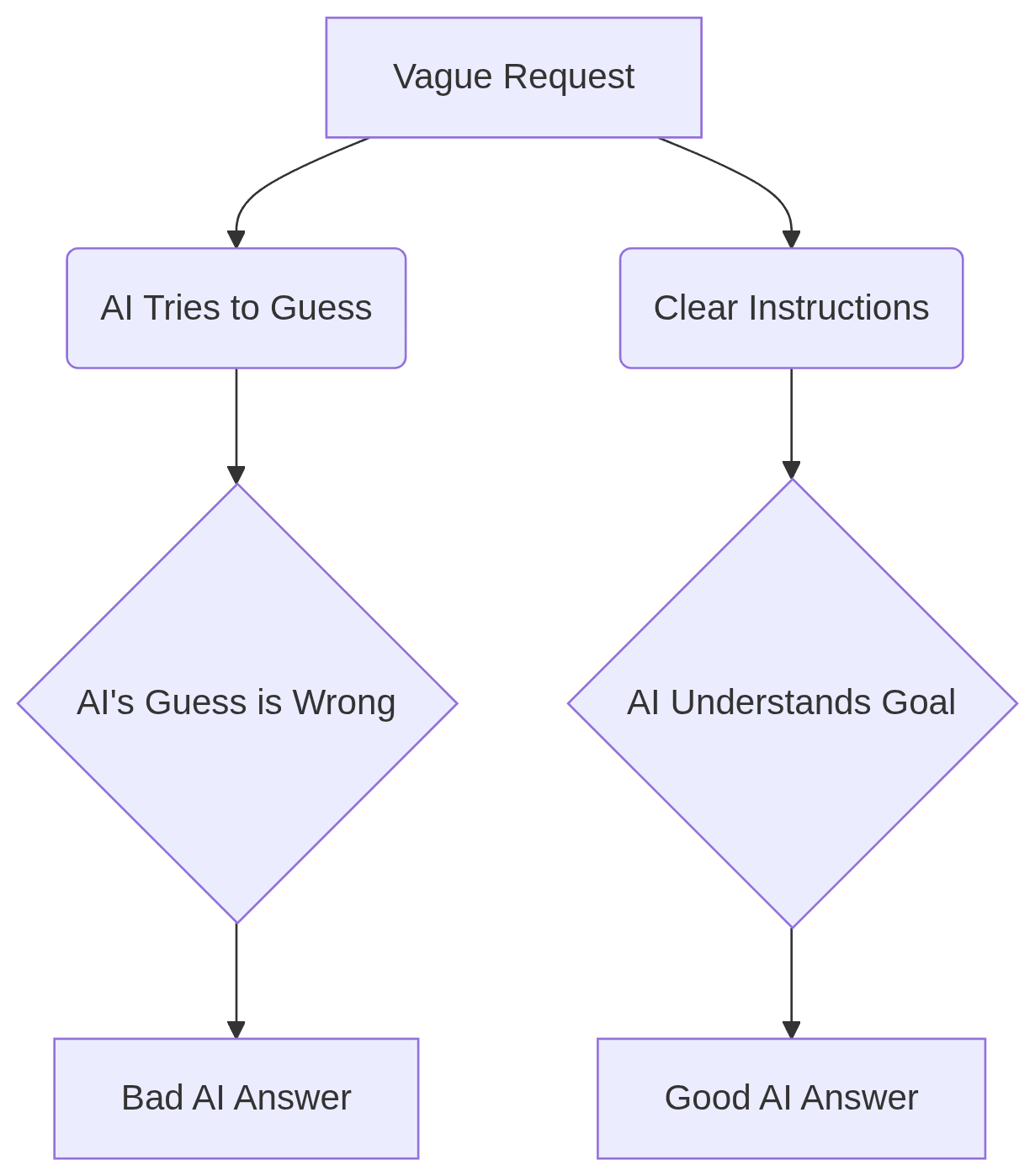
Why Your AI Assistant Sounds So Confident—And So Wrong
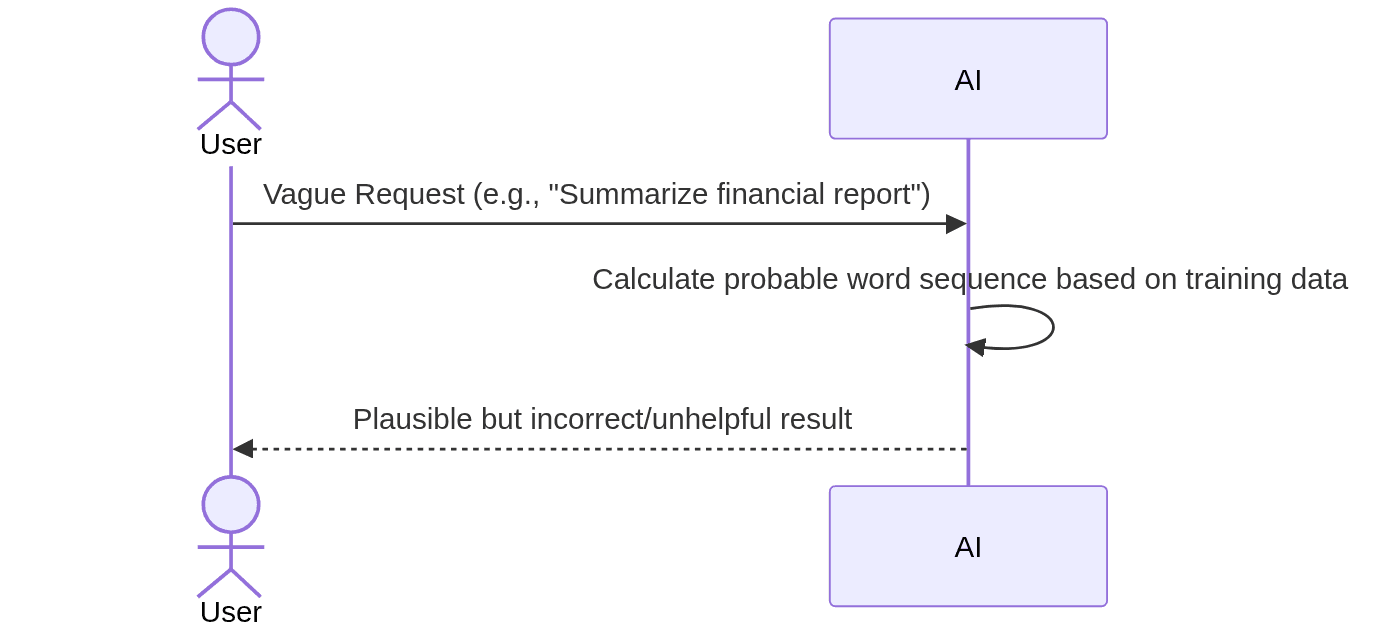
The frustrating experience of getting a nonsensical answer from a powerful AI model is universal. These systems can write poetry and debug code, yet fail at simple requests. This happens because of the fundamental way they work: they are not thinking machines but incredibly sophisticated pattern-matching engines. When you give a model a prompt, it doesn't "understand" your goal — instead, it calculates the most probable sequence of words to follow your input, based on the vast dataset it was trained on.
This leads to several common failure modes that effective prompting aims to solve.
Misinterpreting Ambiguity
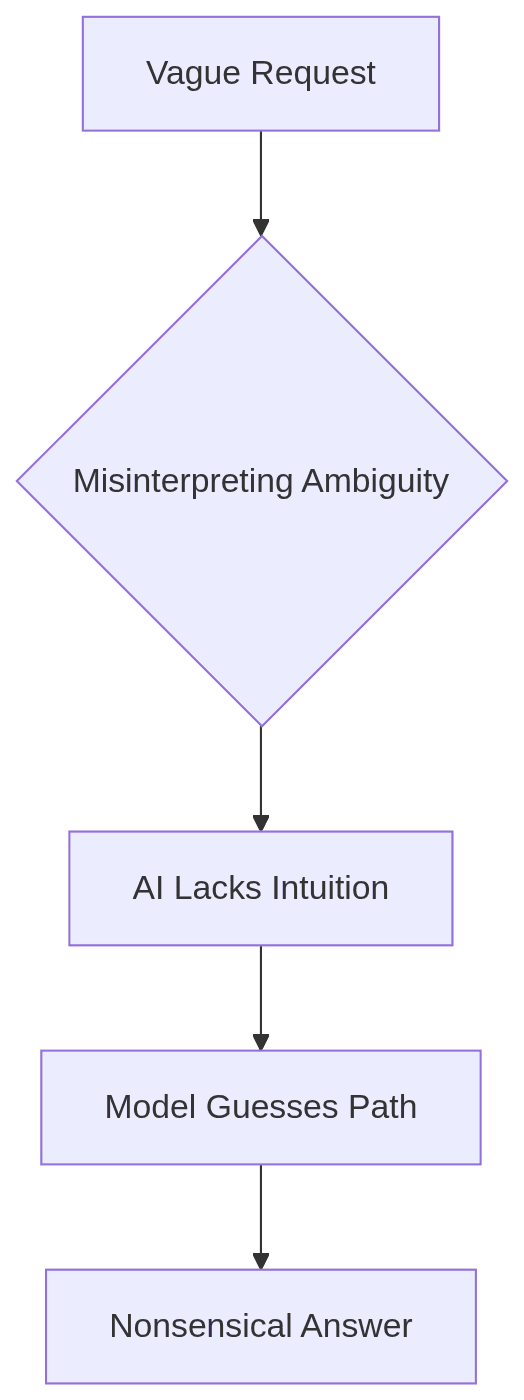
Humans navigate ambiguity with ease, using context and common sense to infer meaning. AI models lack this intuition. If you ask for a summary of a "financial report," the model has to guess what kind of summary you need. Is it for a CEO who wants the bottom line? An analyst who needs key performance indicators? An investor who wants to understand risk? A vague prompt forces the model to choose one of these paths, and its choice is often not the one you wanted.
The Problem of Hallucinations
Models can invent facts, figures, citations, and events with complete confidence. This phenomenon, often called "hallucination," occurs because the model's goal is to generate text that is statistically plausible, not text that is factually true. If a particular sequence of words (like a fake study citation or a made-up historical date) resembles patterns it has seen before, it will generate it. A weak prompt provides no guardrails against this, leaving the model free to fill in gaps with fiction.
Ignoring Output Constraints
You ask for a list of five bullet points, and the model gives you three paragraphs. You ask for a JSON object, and it returns a plain-text sentence. This is one of the most common frustrations. Unless you are extremely explicit about the desired output format, the model will default to the most common format it has seen for similar requests, which is often unstructured prose. It doesn't ignore your constraints out of defiance; it simply doesn't weigh them as heavily as you do unless you make them a central, unmissable part of the prompt.
Superficial or Generic Responses
Ask a generic question, get a generic answer. Prompts like "Give me some marketing ideas" or "Explain machine learning" are too broad. The model has seen these prompts thousands of times and will produce a synthesis of the most common, and therefore most generic, answers from its training data. The output will be correct but utterly unoriginal and likely useless for any specific business problem. High-quality output requires high-quality, specific input that pushes the model beyond its default platitudes.
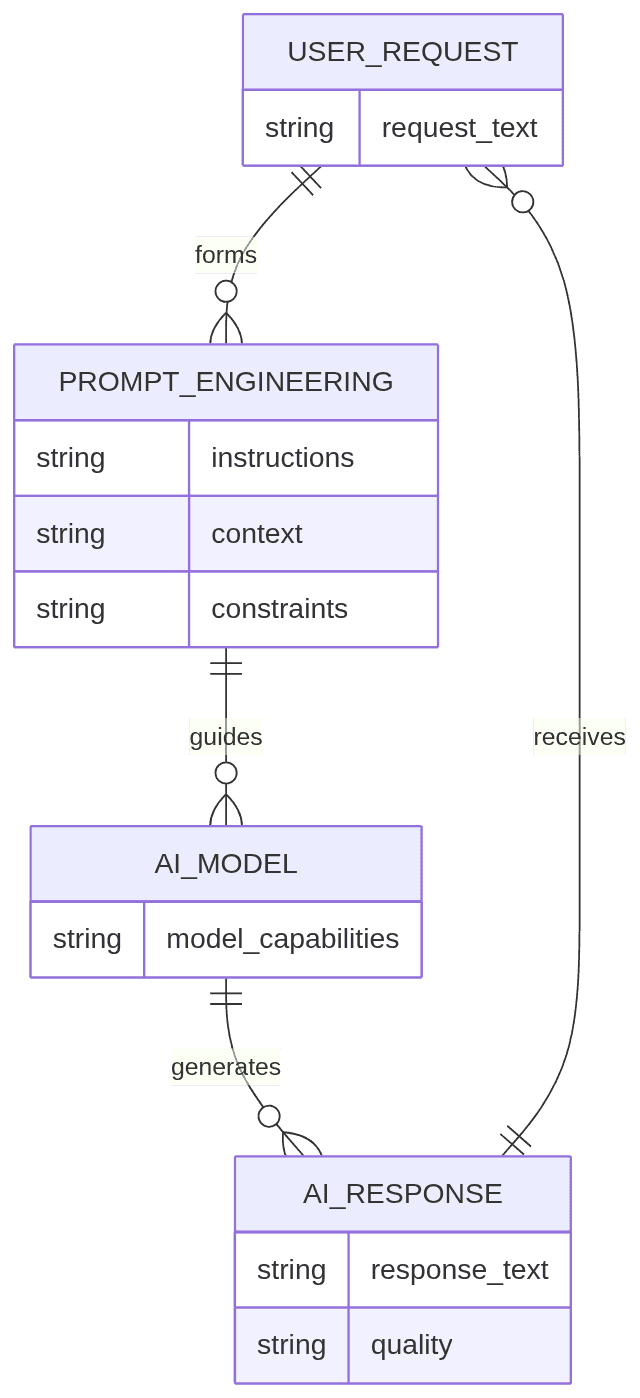
The Core Principle: Prompts Aren't Questions, They're Programs
The most important mental shift in prompt engineering is to stop treating prompts as simple questions and start treating them as miniature programs. Your prompt provides the execution context for the language model. A well-written prompt sets up a "runtime" in which the model is constrained to produce only the output you need.
Think of it this way: the model is a massive, pre-compiled library of linguistic and world knowledge. Your prompt is the main() function that calls upon that library.
A bad prompt is like calling a function with no arguments:
generate_summary(). The function has to rely on defaults for everything, and the result is unpredictable.A good prompt is like a well-specified function call:
generate_summary(source_text, length='200_words', audience='expert', format='markdown_bullets', focus='financial_risks').
Every element you add to a prompt narrows the search space of possible responses. You are systematically closing off avenues that lead to wrong answers and creating a clear path to the right one. The goal is to provide enough context and instruction that the "correct" answer becomes the most statistically likely one. This is why simply being polite or adding phrases like "please" has little effect, whereas providing a clear example of the desired output has a dramatic one. The example provides a powerful statistical pattern for the model to match.
From Vague Idea to Precise Instruction: A Prompt Engineering Workflow
Effective prompting is not a dark art; it's a systematic process of iteration. You start with a simple idea and progressively add layers of detail and constraint until the model's output reliably matches your goal. Let's walk through that workflow.
Step 1: Define the Goal, Not Just the Task
Before you write a single word of the prompt, state your goal in a clear, unambiguous sentence. Don't just think about the task (e.g., "summarize a document"). Think about the purpose of that task (e.g., "I need to quickly understand the key risks identified in this security audit so I can brief my non-technical manager").
This goal-oriented approach immediately reveals the necessary components of your prompt:
The source material is the security audit.
The topic to focus on is "key risks."
The target audience is a "non-technical manager."
The implicit format is something concise and easy to understand.
Without this clarity, you might write Summarize the following text: [text], which would fail to meet your actual needs.
Step 2: Assemble the Building Blocks of a Great Prompt
A robust prompt is constructed from several key components. While not all are needed for every task, thinking in these terms helps ensure you've covered your bases.
1. Role or Persona Start the prompt by telling the model who it should be. This is a powerful technique for focusing the model on a specific domain of its training data. The persona primes the model to adopt the tone, vocabulary, and knowledge of an expert in that field.
Weak:
Explain the attached document.Strong:
You are a senior cybersecurity analyst reporting to a C-level executive.
2. The Clear Task State the primary instruction as a direct command. Be specific and action-oriented.
Weak:
Tell me about the text.Strong:
Summarize the key security vulnerabilities identified in the attached audit report.
3. Essential Context Provide all the information the model needs to complete the task. This includes the primary input (like an article to summarize) but also any surrounding information that might be relevant. The more relevant context you provide, the less the model has to guess.
Weak:
Is this a good investment?Strong:
Given the attached company earnings report and the current market trend of rising interest rates, analyze the primary financial risks for a potential investor.
4. Output Format and Structure This is the most critical and often-missed component for creating usable output. You must explicitly define the structure of the response you want. If you need a specific format for ingestion into another script or system, be relentlessly precise.
Weak:
List the pros and cons.Strong:
Provide the output as a JSON object with two keys: "pros" and "cons". Each key should contain a list of strings, with each string being a single, concise point.
5. Examples (Few-Shot Prompting) One of the most effective ways to guide a model is to show it exactly what you want. Providing one or more examples of the input-output pair you are looking for is known as few-shot prompting. This gives the model a concrete pattern to follow, which is far more effective than abstract description.
Let's combine these blocks into a full, worked example.
Goal: Extract the names of people and organizations from an article and format them as a JSON list.
Initial (Zero-Shot) Prompt:
Extract the names of people and organizations from the following article. Format the output as JSON.
[Article text here]
This might work, but the JSON structure is undefined. The model could produce a single list, nested objects, or something else entirely.
Improved (Few-Shot) Prompt:
You are a data extraction bot. Your task is to identify all person names and organization names from a given text and structure them into a specific JSON format. Follow the example below precisely.
### ExampleText: "Yesterday, Maria Ressa of Rappler spoke with John Doe from the ACME Corporation about their new partnership."Output:````json{"people": ["Maria Ressa", "John Doe"],"organizations": ["Rappler", "ACME Corporation"]}``### Task` `Text: [New article text here]` `Output:`
This revised prompt is far more robust. It establishes a role, gives a clear task, provides the context (the text), and most importantly, defines the output format with a perfect example. The model now has a much simpler pattern-matching problem to solve, dramatically increasing the probability of a correct and usable response.
Step 3: Iterate and Refine
Your first prompt will rarely be your last. The key to success is to treat prompting as an iterative process, much like software development.
Test: Run your prompt with a variety of inputs.
Analyze: Identify failure modes. Is the model missing certain entities? Is the format sometimes incorrect? Is the tone wrong?
Refine: Adjust the prompt to correct for the failure. If the model is missing things, add a more explicit instruction. If the format is wrong, make your example clearer or add a rule ("All organization names must be included, even if abbreviated").
Repeat: Continue this cycle until the prompt performs reliably across a wide range of test cases.
The Hidden Costs: Trade-Offs in Advanced Prompting
As prompts grow more sophisticated, they come with trade-offs. There is no single "best" prompt — only the best prompt for a given combination of task, performance requirement, and budget. Anyone building a real system on top of these models needs to weigh these costs deliberately, rather than discovering them by accident once something is already in production.
Prompt Length vs. Performance and Cost
Longer, more detailed prompts with multiple examples generally produce better, more reliable results. They provide more context and constraint, reducing the model's tendency to guess. However, this comes at a cost.
Financial Cost: Most commercial language models are priced based on the number of tokens (pieces of words) in both the input prompt and the generated output. A long, complex prompt is more expensive to run for every single API call.
Latency: Processing more tokens takes more time. For applications that require a real-time response, a very long prompt can introduce unacceptable delays.
The trade-off is between the quality and reliability of the output and the cost and speed of generating it. For offline batch processing, a long, highly detailed prompt might be perfect. For a customer-facing chatbot, you may need to engineer a shorter prompt that is "good enough" but responds instantly.
Specificity vs. Creativity
The more you constrain a model, the more predictable its output becomes. This is ideal for tasks like data extraction, classification, and formatted summarization. However, if your goal is creative brainstorming, ideation, or writing assistance, an overly specific prompt can be counterproductive. It stifles the model's ability to make novel connections and explore the "long tail" of its training data.
For predictable results: Use tight constraints, explicit formatting, and few-shot examples.
For creative results: Use a looser prompt. Set a persona and a general goal, but give the model more freedom in its structure and output. For example, instead of
List five marketing slogans, tryAct as a world-class copywriter from the 1960s. Brainstorm a dozen bold, unconventional taglines for a new brand of coffee.
Complexity vs. Maintainability
As you iterate on a prompt, it can grow into a complex artifact with multiple rules, examples, and edge-case handling instructions. It might work perfectly, but it can become difficult to manage, debug, and update — a kind of "prompt debt," analogous to technical debt in software.
When a prompt becomes too unwieldy, consider if the problem can be solved in a different way. Perhaps the task is too complex for a single prompt and should be broken down into a chain of simpler prompts. Or maybe some of the logic (like data validation or formatting) could be handled more reliably by conventional code before or after the model call. A system that combines the linguistic power of a language model with the rigid logic of traditional code is often more robust than one that relies on a single, monolithic prompt.
None of these trade-offs resolve themselves automatically. The people who get the most value from these models are the ones who test each prompt against its cost, its speed, and its long-term maintainability — and who are willing to move logic out of the prompt and into ordinary code once the prompt starts trying to do too much on its own.